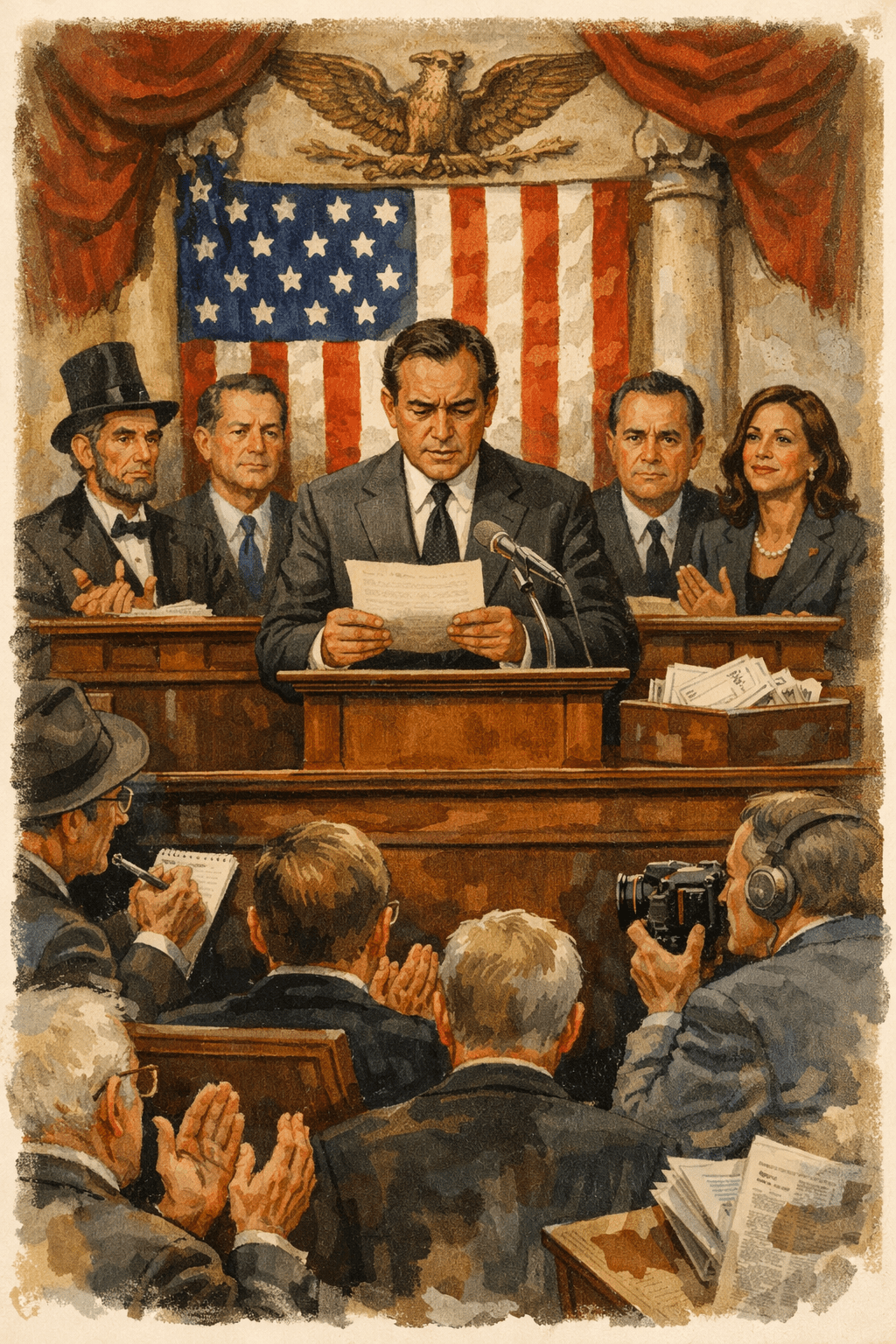
American democracy contains a few rituals so strange that they almost feel like political theater.
One of them unfolds every four years in the House chamber. Congress gathers. Envelopes from the states are opened. Electoral votes are read aloud. Cameras roll. Applause occasionally breaks out.
And presiding over the entire ceremony sits the Vice President of the United States.
Most years that arrangement produces nothing unusual. But every once in a great while the Constitution engineers a quietly awkward moment: the Vice President presides over the certification of the presidential election he just lost.
The defeated candidate must stand at the lectern and formally declare the victory of the rival who beat him.
American political history contains many close elections. It contains many bitter defeats. Yet this particular moment has happened only a handful of times.
The rarity makes the trivia interesting.
The personalities involved make the story fascinating.
And one of them—John C. Breckinridge—occupies one of the strangest corners in the entire American political narrative.
The First Time: A Calm Moment Before the Storm
The first instance occurred in February 1861.
The Vice President that day was John C. Breckinridge of Kentucky, who had just finished losing the presidential election to Abraham Lincoln in the fractured four-way contest of 1860.
The country was already coming apart.
Southern states had begun seceding from the Union. Washington buzzed with rumor and dread. Newspapers openly debated whether the Republic could survive.
Yet the constitutional machinery still turned.
Breckinridge took his seat at the Senate lectern and presided over the count of electoral votes. One by one the envelopes were opened. One by one the states reported their results.
When the tally finished, Breckinridge calmly announced that Abraham Lincoln had received a majority of the electoral votes and was therefore elected President of the United States.
The scene contains one of history’s great ironies.
Within months Breckinridge would leave Washington, join the Confederacy, become a Confederate general, and eventually serve as Confederate Secretary of War.
Yet for one quiet afternoon in the House chamber, the future Confederate officer fulfilled the constitutional duty of certifying Lincoln’s victory.
History rarely produces cleaner examples of paradox.
A Century Later: Richard Nixon
Almost exactly one hundred years later, the same awkward duty fell to Richard Nixon.
On January 6, 1961, Nixon presided over the certification of the election he had just lost to John F. Kennedy.
The 1960 election had been razor thin. Allegations of irregularities floated through Illinois and Texas. Nixon could have pressed the issue harder than he did.
He chose not to.
Standing at the lectern that day, Nixon even noted the historical echo of Breckinridge’s moment a century earlier. Then he calmly announced Kennedy’s victory.
The gesture has largely disappeared from popular memory, overshadowed by the darker chapters that would follow Nixon’s career.
Yet the moment reveals a different side of him.
Nixon could be ruthless in politics. He could also be disciplined about institutions. When the constitutional process required him to certify his opponent’s victory, he did it without spectacle.
Thirteen years later, Nixon would face another moment requiring a humiliating concession.
Nixon’s Second Exit
In August 1974 the Watergate scandal finally forced Nixon to confront the collapse of his presidency.
The situation was different. This time he was not announcing someone else’s victory. He was announcing his own departure.
Yet the pattern remained strangely familiar.
Nixon did not cling to the office until the last procedural lever broke. Instead he addressed the nation, acknowledged the crisis facing the country, and announced that he would resign the presidency the following day.
For a politician famous for combat, the final acts of Nixon’s career contain an odd symmetry: twice he stepped away from power when the constitutional moment demanded it.
The man had many flaws. Institutional awareness was not one of them.
The Modern Example
The next instance came in 2001.
Vice President Al Gore, after losing one of the most contested elections in modern history, presided over the certification of George W. Bush’s victory.
Members of the House attempted to challenge Florida’s electoral votes. The law requires objections from both chambers of Congress.
No senator joined the protests.
Gore ruled the objections out of order, one after another, until the count concluded and Bush’s victory was declared.
The defeated candidate enforced the rules that confirmed his own loss.
That moment captures something essential about the American constitutional system. The system does not depend solely on laws. It depends on individuals willing to obey those laws when obedience is inconvenient.
The Latest Addition to the List
In January 2025, Vice President Kamala Harris joined the list when she presided over the certification of Donald Trump’s victory in the 2024 election.
Her approach was almost deliberately understated. The session proceeded calmly. The tally was read. The result was declared.
Another awkward constitutional ritual completed.
Why the Ritual Matters
The Constitution contains many brilliant structural ideas—separation of powers, federalism, checks and balances.
But some of the most important safeguards are simpler.
They are rituals.
They are moments that force political rivals to participate in the peaceful transfer of power.
Occasionally those rituals require a defeated candidate to do something profoundly uncomfortable: stand before the nation and formally declare that someone else has won.
John Breckinridge did it on the eve of the Civil War.
Richard Nixon did it after one of the closest elections in American history.
Al Gore did it after the Supreme Court settled a national dispute.
Kamala Harris did it in the polarized politics of the twenty-first century.
The personalities differ. The eras differ. The tensions differ. Yet the choreography remains the same.
The defeated candidate steps forward.
The envelopes are opened.
And the Constitution quietly insists that the loser announce the winner.
Author’s note: Research and drafting assistance for this piece came from ChatGPT. The machine helped with the history; the opinions, tone, and occasional mischief belong to the author.