

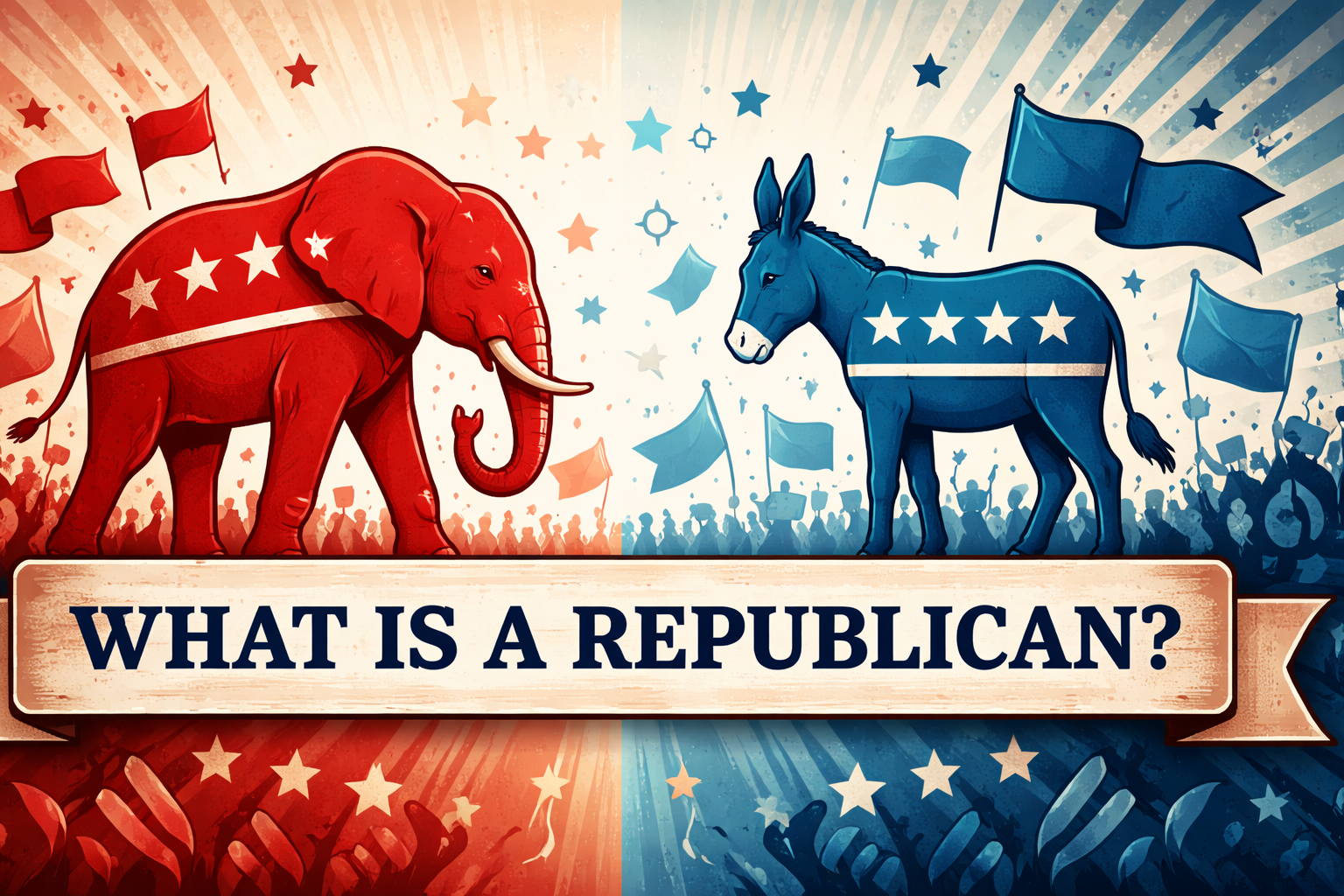
At a recent Knox County Republican meeting, someone asked a simple question: What is a Republican?
The question was sincere—and revealing.
The first problem was not the answer given, but the assumption built into the question itself. The question assumed that “Republican” describes an identity in the same way “Christian,” “atheist,” or “libertarian” might. It does not.
The first question to ask is not What is a Republican?
The first question is What is the Republican Party?
A party is not an identity.
A party is not a creed.
A party is not a purity test.
A party is a coalition formed for the purpose of governing.
A Republican, then, is a member of a party whose purpose is not self-expression, but coalition-building for the purpose of governing. Politics exists to do things, not to tell people who they are.
If someone needs to be something, there are better places to look. Faith provides identity. Family provides identity. Work, community, and vocation provide identity. Politics was never meant to fill that role.
If someone wants to do something—if someone wants to govern—then they join a party. They bring convictions. They bring priorities. They bring experience. But they leave dogma at the door.
Colonel John Boyd captured the tradeoff bluntly: you can be somebody, or you can do something—but not both.
Coalitions govern.
Identities perform.
A party that confuses performance for governing deserves neither power nor patience.
Parties Are Not Creeds
Much of the confusion in modern politics comes from treating party affiliation like religious belief.
Asking whether someone is Republican or Democrat is not like asking whether someone is Christian or atheist. That question concerns belief and identity. Party affiliation concerns coordination and action.
A better analogy is this: asking whether someone is Republican or Democrat is like asking which team they are willing to play on so the game can be played at all.
Beliefs give meaning.
Institutions produce outcomes.
This distinction matters because the American two-party system works very differently from many European political systems. In much of Europe, parties are explicitly identity-linked. Voters select parties that closely match ideology, class, religion, or region. Coalition governments are formed after elections.
The American system reverses that logic. Winner-take-all elections force coalition-building before elections. Parties must absorb disagreement internally so that the republic does not fracture externally. That is not a flaw in the system. That is the design—a design that has lasted as the longest standing democracy in the modern world.
Which brings us to party realignment.
Why Party Realignment Matters
The party realignment argument is essential to this discussion because it explains why the American two-party system endures at all.
American parties do not exist to preserve fixed identities. They exist to assemble governing majorities. To do so, each party must evolve over time, absorbing new voters, new priorities, and new constraints as conditions change. New issues emerge. Old coalitions weaken. Voters move.
Realignment is not ideological betrayal.
Realignment is institutional adaptation.
Across American history, both major parties have repeatedly changed their internal composition in response to civil rights, federal authority, cultural conflict, immigration, economic regulation, trade, foreign policy, and populist movements. The labels “Republican” and “Democrat” remained, but the coalitions underneath them shifted—sometimes dramatically.
The graphs below illustrate that reality across multiple issue domains. They show movement, crossing, and reversal over time. They show that America’s two parties are not static containers of belief, but living systems responding to pressure.
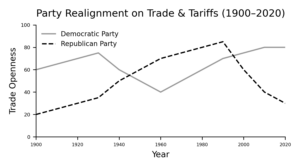
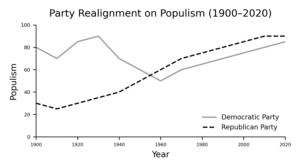
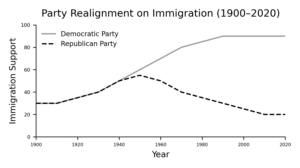
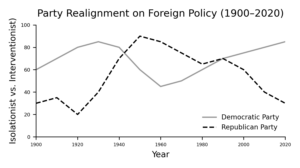
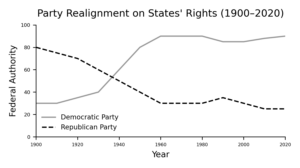
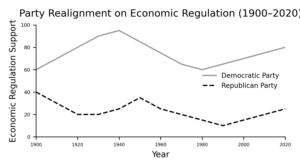
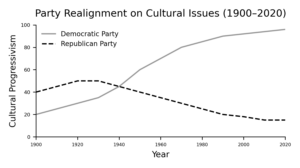
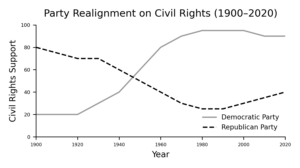
These graphs are from the second edition of my book The Art of the Compromise where I offer a more detailed discussion of party realignment as well as the importance of the American two-party political system.
The parties are not dead slaves to dogma.
They are adaptive institutions competing for the authority to govern.
“Okay, Then What Is a Democrat?”
At this point, a reasonable reader may object.
Fine. If that is what a Republican is, then what is a Democrat?
Have we actually answered the question, or have we just dodged it?
The objection is fair—and clarifying.
A Democrat is the same kind of thing a Republican is.
A Democrat is a member of a party whose purpose is not self-expression, but coalition-building for the purpose of governing. The Democratic Party is a governing coalition assembled under different priorities, constraints, and voter alignments at a given moment in time. Like the Republican Party, it has evolved repeatedly as those coalitions have shifted.
The difference between Republicans and Democrats is not what they are, but how they are presently constituted—which voters they aggregate, which interests they prioritize, and which compromises they are willing to make to assemble a majority.
Both parties perform the same institutional function.
Both exist to translate disagreement into action.
Why This Is Not a Dodge
Some readers may still feel unsatisfied. The instinct is understandable. The question What is a Republican? sounds like it should produce a list of beliefs or traits.
But that expectation reflects the very confusion this essay is trying to correct.
The question is not being dodged.
The question is being properly categorized.
Asking What is a Republican? as a matter of identity is like asking What is a wrench? and expecting a worldview rather than a function. A wrench can be used well or badly. It can be applied to different tasks. It can even be misused. But its defining feature is not belief. It is purpose.
Political parties are tools of governance.
Beliefs enter politics through parties, but parties are not defined by belief alone. They are defined by whether they can assemble, discipline, and sustain a governing majority under constitutional constraints.
When parties are treated as identities, politics becomes theater.
When parties are treated as coalitions, politics becomes work.
Coalition Still Needs a Platform
None of this means that parties should stand for nothing.
A coalition without boundaries is not adaptive. It is incoherent. A party must articulate a platform—not as a purity test, but as a governing baseline. A platform defines what members are prepared to fight for together, even when they disagree on everything else.
The familiar warning still applies: if you do not stand for something, you will fall for anything. But that “something” must be limited, shared, and enforceable—not totalizing or ideological.
A platform disciplines a coalition. It sets priorities. It imposes tradeoffs. It clarifies what compromises are acceptable and which are not. Without that structure, a party becomes reactive, opportunistic, and incapable of sustained governance.
This is the distinction that matters:
- Dogma demands belief.
- Platforms demand action.
Dogma polices identity.
Platforms coordinate effort.
A healthy party evolves its platform over time as coalitions shift, but it never abandons the idea of a platform altogether. Adaptation without structure becomes drift. Structure without adaptation becomes fossilization. Governing requires both.
Returning to the Original Question
So, what is a Republican?
A Republican is a participant in a governing coalition organized to win elections and exercise power responsibly under the Constitution.
What is a Democrat?
The same—assembled differently.
The real divide in American politics is not between Republicans and Democrats as identities. It is between those who understand parties as institutions for governing and those who treat parties as vehicles for self-expression.
Madison designed a system that assumes disagreement.
Lincoln held together a coalition no purity test could survive.
Col. Boyd reminded us that action requires surrendering identity.
Those lessons remain intact.
Coalitions govern.
Identities perform.
A party that forgets this distinction—on either side—ceases to be a governing institution and becomes a stage.
A party without a platform is unserious. A party that treats its platform as scripture is dangerous.
Disclosure: This essay was drafted with the assistance of ChatGPT, which functioned as a research assistant, editor, and occasionally an unlicensed political theorist. All arguments, judgments, and any resulting offense remain entirely my own. Any errors are the responsibility of the human, not the machine—though the machine did warn me several times.