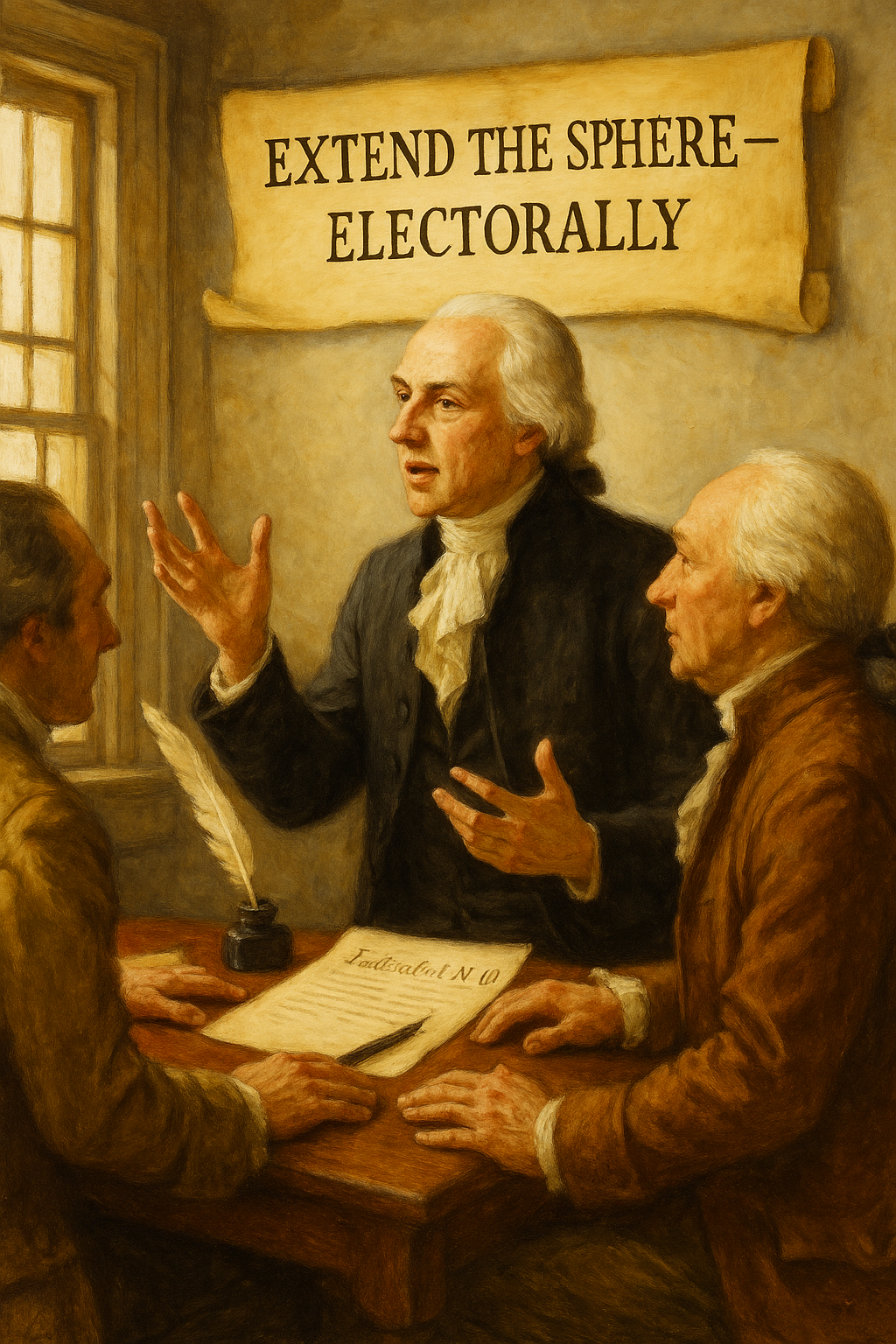
James Madison’s remedy for faction was not merely more map; it was more mixture. In James Madison’s famous argument in Federalist No. 10, he wrote that a large republic helps “control the mischiefs of faction” by bringing “a greater variety of parties and interests.” Extending the sphere does not demand a territorial expansion—it demands a broader public engaged in selecting representatives.
Closed primaries invert Madison’s logic. They restrict nomination to a narrow electorate: registered party members, often highly motivated activists or interest-group adherents. Purity tests shrink the selectorate—the group legally permitted to choose a nominee—to a small, insular pool, my metaphor’s “low waterline” in Fig. 1. Each local faction becomes its own “basin,” selecting candidates shaped by narrow interests and little regard for statewide cohesion or cross-district compromise. Observe the animation in Fig. 1 below.
This animation illustrates a political world that does not exist—but one that some advocates of closed primaries imagine. In the opening frame, the broad electorate produces representatives with varied values, represented by different colors. The implication is that an open primary system dilutes conservative strength because nominees must appeal to a wider set of voters.
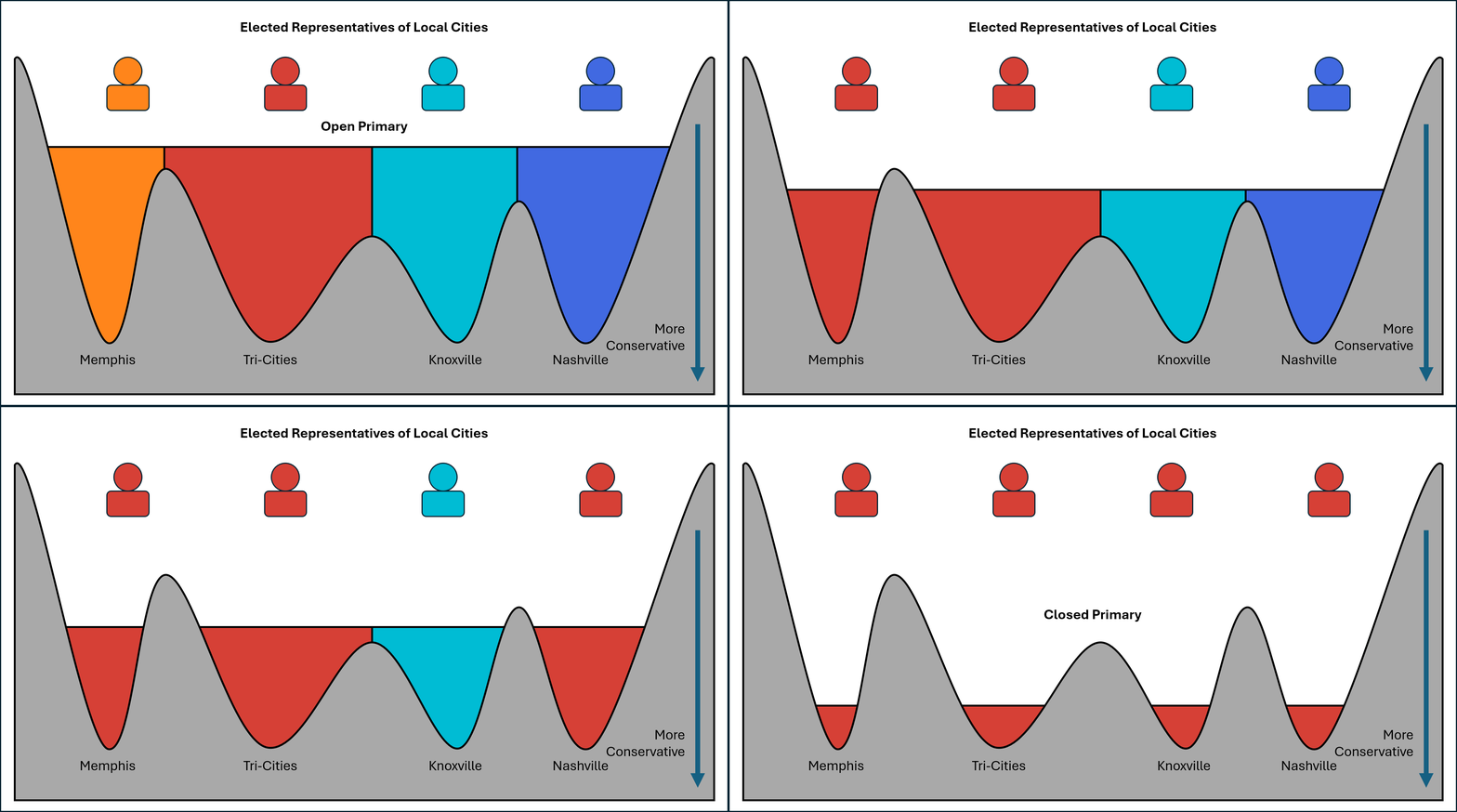
Figure 1. A world that does not exist. An watershed illustration of how some believe closed primaries will purify representatives.
In the final frame, small reservoirs form when the electorate is restricted to “pure Republicans.” The imagined outcome is a delegation of representatives who share a single, uniform set of conservative principles. In that world, every district taps into the same ideological waterline, and conservative legislation moves through the process without resistance, because no representative deviates from the assumed common level.
But such a world does not exist. The underlying assumption—that all Republican voters sit at the same ideological elevation—collapses under the most basic local observation. Knox County alone contains multiple Republican clubs, each with its own priorities, factions, leadership personalities, and internal disagreements. These variations reflect real differences in local political culture, not impurities introduced by outsiders. A closed primary does not level these ideological reservoirs; it merely shrinks the electorate until the local terrain dominates. The reservoirs stay different because the communities stay different.
The Madisonian lesson is that enlarging the sphere does not weaken a coalition. Expanding the nominating electorate blends local variations into broader currents, creating representatives who can forge stable coalitions in the legislature. Shrinking the sphere does not purify a party—it fractures it. The animation shows the imagined world versus the real one, and the real one has always been shaped by diversity within the party, not uniformity imposed by closing the door.
In contrast, open primaries (or semi-open as we have in Tennessee) raise the waterline: many more voters—independents, lightly affiliated citizens, moderate partisans, committed partisans—can influence nominations. As in a watershed-transform metaphor, once water rises above the “saddle points,” isolated basins merge into a larger basin. Nominees must appeal to a broader ideological terrain, increasing the chance that representatives emerge with broader coalitions already baked in and not handcuffed to local versions of ideological purity. Consider animation if Fig. 2 below.
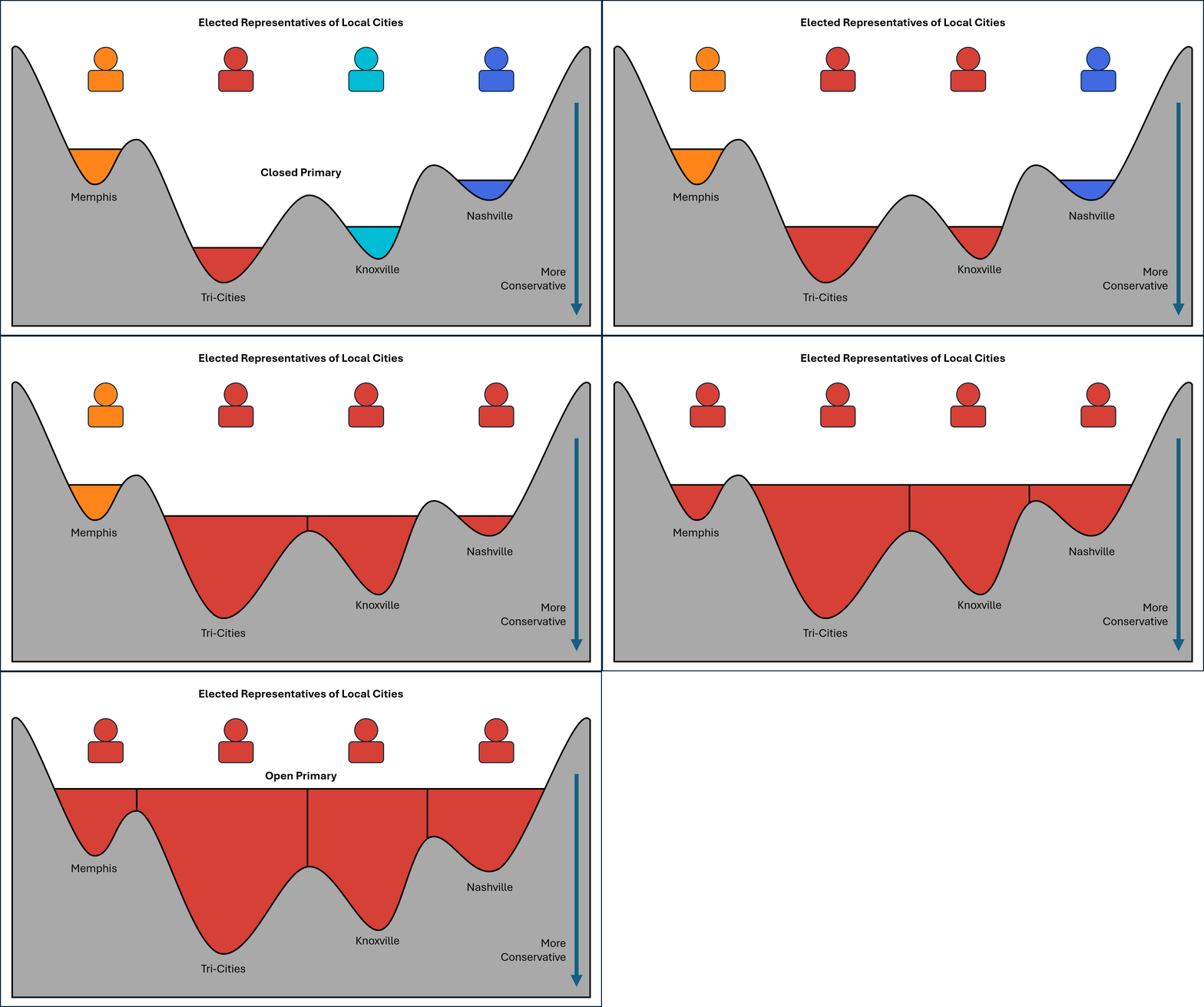
Figure 2. Local conservative values differ across communities. Semi-open primaries expand the voter pool, merging these variations and baking broader coalitions into the primary stage—an effect supported by evidence from states using open and closed primary systems.
This animation begins with a political landscape shaped by local variation—a more realistic political terrain. Each community sits in its own valley, and each valley rests at a different ideological elevation. The colors represent the political character of those communities—not partisan labels, but the lived reality of distinct local cultures. In this starting frame, the reservoirs reflect the full population of each area because the primary is semi-open. Eligible voters, who align with the GOP, can participate, so each pool fills according to the actual distribution of values in the community.
As the animation progresses, the waterline slowly rises—the voter pool expands. When more citizens participate, the reservoirs deepen and begin to merge. Local biases still matter, but they no longer dominate. Broader coalitions form as the “rising waterline” connects basins that once stood apart. Representatives chosen from these merged basins must appeal beyond the smallest and loudest factions. They carry with them a more complete picture of the people they represent.
The key point is that open primaries do not erase local differences; they integrate them. The animation helps the reader see that real communities are not identical. Knoxville does not look like the Tri-Cities; Memphis does not look like Nashville. Each one has its own ideological terrain. When primaries are open, the nominees must compete across that genuine landscape, shaping coalitions that reach across broader and more diverse electorates.
This argument is where the Madisonian logic enters: extending the sphere reduces the ability of narrow factions to capture the process. Open primaries enlarge the electoral sphere, not geographically but electorally. They acknowledge that political life is shaped by real communities with real differences—and they require candidates to build coalitions large enough to govern, not just small enough to win a factional purity contest.
This argument aligns with a broader literature on coalition size and political incentives. The core insight from Selectorate Theory is that leaders backed by small, narrow selectorates tend to cater to particularistic interests and private goods (the Peacock Problem), while leaders who must satisfy larger winning coalitions are more likely to provide public goods and broader representation. A pure party representative, selected by a few, may win a prancing contest, but a party representative with broad support wins general elections (the Pure Breed Problem).
This logic extends to U.S. primaries: when only a narrow, mobilized base picks nominees, those nominees are more likely to carry extreme or narrowly tailored positions. In contrast, broader primaries dilute narrow factional influence and encourage moderation or broader appeal.
This watershed metaphor helps re-center the debate by shifting focus from party labels to selectorate structure. It emphasizes that political fragmentation isn’t just about partisan identity, but about the breadth and inclusivity of the pool that chooses nominees. With broader participation (semi-open primaries), local ideological “puddles” are forced to merge—giving the party electorate more of a say in shaping the constellation of interests that ultimately enters the legislature.
In that sense, open and semi-open primaries offer a Madisonian remedy for modern party fragmentation—not by redistributing land, but by raising the political waterline, expanding the pool of voices, and encouraging coalition-driven representation before lawmakers even take office.
Disclosure: I used ChatGPT as a research and drafting assistant in preparing this post. The arguments, interpretations of Madison, and final editorial judgment remain my own.