Rebuilding a Strong Knox County GOP Through Structure, Not Personalities
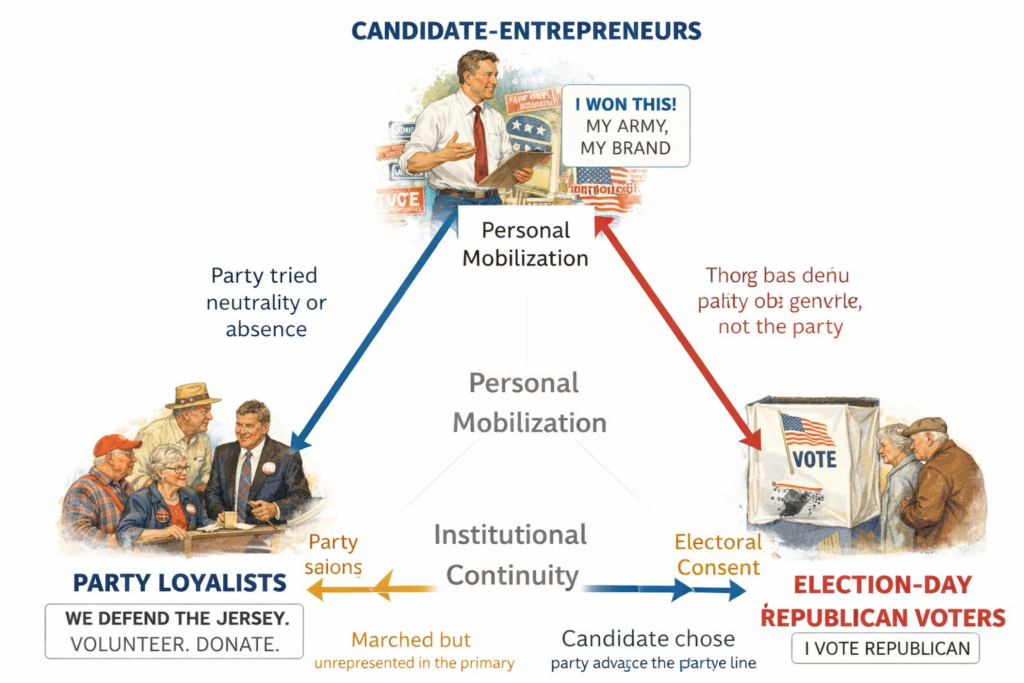
Knox County Republicans often argue about candidates, messaging, or ideology. Those arguments miss a deeper problem. The deeper problem lies not in beliefs but in structure—specifically, in how the local party now selects candidates and how legitimacy gets distributed once elections are over. The current system quietly produces three political actors who operate under different rules, claim authority from different sources, and frustrate one another without fully understanding why.
The first actor is the modern candidate who builds a campaign from scratch. Local primaries reward this model. Candidates recruit volunteers from church groups and neighborhood networks, raise money through personal contacts, assemble voter lists piecemeal, and run turnout operations with improvised tools. Victory under these conditions teaches a clear lesson. The win came from personal effort, not institutional backing. The campaign team belongs to the candidate. Loyalty flows inward. From that experience follows a natural conclusion: the party did not create the win, and therefore the party cannot claim ownership of the result.
This candidate does not emerge hostile to the party. The candidate emerges independent of obligation. When expectations appear after the election—requests for message coordination, caucus strategy, or collective discipline—those expectations feel unearned. The hard work already happened. The candidate won the primary with little to no party support—by design. Thus the candidate’s subsequent independence feels justified.
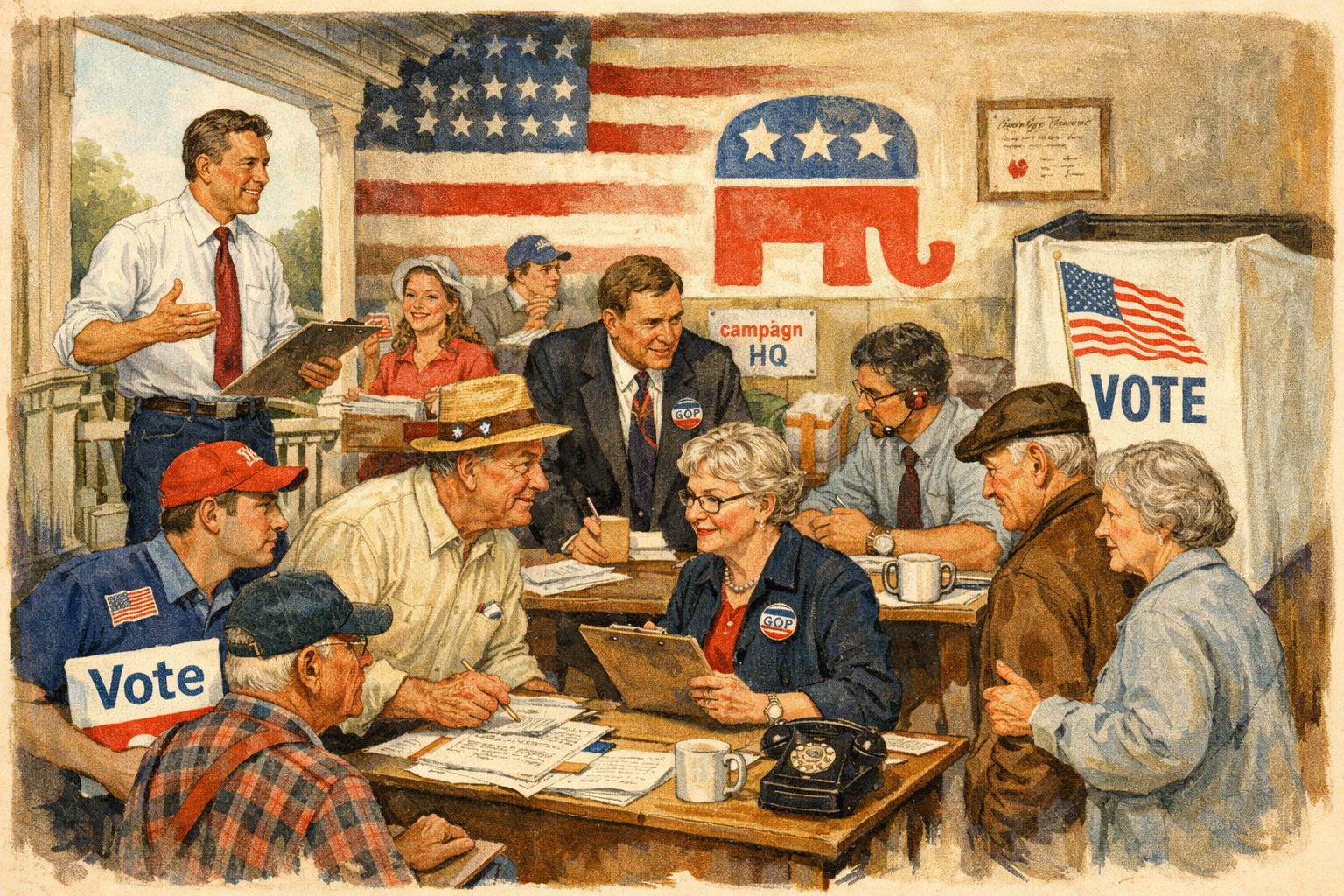
The second actor is the party loyalist. This group carries institutional memory. Party loyalists knock doors in November, staff phone banks, defend nominees on social media, and show up when the ticket needs help. Party loyalists believe parties precede candidates. The jersey matters more than the name on the back. Unity in general elections matters because governing power depends on winning as a team.
Party loyalists often support candidates they did not recruit and did not advise during the primary. That support reflects discipline and long-term thinking. Trouble arises after the election, when those same candidates dismiss party coordination, reject shared strategy, or treat party leadership as optional. Party loyalists feel used. Time was given. Reputation was risked. Effort was expended. Authority was denied.
The third actor rarely enters these disputes at all. The election-day party voter shows up in November, selects Republican on the ballot, and returns to private life. This voter does not attend meetings, does not volunteer, and does not join campaign armies. That behavior does not signal apathy. That behavior reflects trust. Republican theory assumes intermediaries. Voters assume the party filtered candidates before Election Day. The party label functions as a shortcut for coalition membership and governing seriousness.
This voter grants legitimacy in bulk but exercises little oversight. When conflict erupts between candidates and party leaders, confusion follows. Responsibility appears diffuse. Accountability appears unclear. The voter expects coherence without participating in the internal process that produces coherence. In the general election, the party voter delivers victory for the candidate—culminating the hard won primary victory.
Each of these three actors claims legitimacy from a different source. The candidate claims legitimacy from personal mobilization In the primary. The loyalist claims legitimacy from institutional continuity to maintain the party across elections. The voter claims legitimacy from electoral consent in the general. Those claims do not overlap. Each actor behaves rationally within the incentives provided. Together, those rational behaviors generate instability.
Knox County has already seen the consequences. In more than one recent primary, a candidate assembled a small but disciplined volunteer army, won a low-turnout race, and entered office owing nothing beyond gratitude. Party loyalists who knocked doors for the ticket in November later watched coordination break down during key votes and public messaging. The candidate claimed independence. Party workers felt discarded. Voters saw inconsistency. None of these reactions reflected bad faith. Each followed logically from the structure that produced it.
The system rewards energy while severing reciprocity. No “scratch my back and I’ll scratch your back” among the three actors. Candidates learn independence without obligation. Party loyalists offer loyalty without leverage. Voters delegate filtering without enforcement. No actor holds both authority and responsibility. Each assumes another actor should supply what remains missing.
Strong parties once resolved this tension by aligning investment with obligation. Parties recruited candidates early. Parties provided voter data, turnout operations, and campaign basics. Parties trained future legislators in how governing coalitions actually function. In return, candidates accepted discipline and governed as members of a team. That model limited independence but increased coherence. Expectations were established before ballots were cast rather than after offices were won.
Blame for this breakdown is varied and has some connection to digital shrinking of today’s politics and the lowering the barriers among these actors to engage one another—but that blame is perhaps as another post.
A path forward begins with restoring reciprocity. Party infrastructure must exist before campaigns begin, not as a cleanup crew after primaries end. A county party that maintains shared voter files, baseline turnout operations, volunteer training, and coordinated messaging makes a real investment in every candidacy. Candidates who rely on that infrastructure enter races as members of a coalition rather than founders of startups. Support then carries expectation, not surprise. The path forward is a stronger party structure to build and support primary candidates rather than requiring them to build campaigns from scratch.
Candidate support must also imply obligation in visible ways. Endorsements should follow structured conversations about legislative priorities, committee work, and coalition strategy. Candidates should be asked how governing fits into a team effort, not merely how many doors a campaign can knock. A nominee who rejects coordination at the front end should not encounter surprise demands at the back end.
Party participation must also confer influence. Party loyalists who recruit volunteers, staff events, and sustain institutions should see that effort translate into a voice in recruitment and strategy. Influence cannot depend solely on proximity to a candidate’s inner circle. A party that channels effort into decision-making strengthens loyalty without demanding obedience.
Selection should test governing capacity rather than organizational theatrics alone. A candidate who excites a compact army demonstrates energy. Yet, a candidate who explains policy tradeoffs, accepts constraints, and operates within a coalition demonstrates readiness to legislate. Parties can surface that distinction through policy forums, structured interviews, and public discussions that reward clarity, patience, and seriousness rather than volume and outrage. Energy fades when the true grit of legislating gets hard. No wonder the three actors are confused and misaligned with one another’s actions.
Such adjustments do not weaken democracy. Such adjustments strengthen republicanism by aligning effort with authority, legitimacy with obligation, and enthusiasm with governance.
Compromise is never easy, and compromise remains unsuitable for the weak. Institutions, like people, must earn loyalty through investment. Only then can loyalty be expected in return.
The Knox County GOP must pursue efforts to rebuild strength as a governing and collective party.
Author’s note: This essay was developed with the assistance of ChatGPT, serving as a research and drafting aide. The arguments, judgments, and conclusions remain my own—for better or worse.