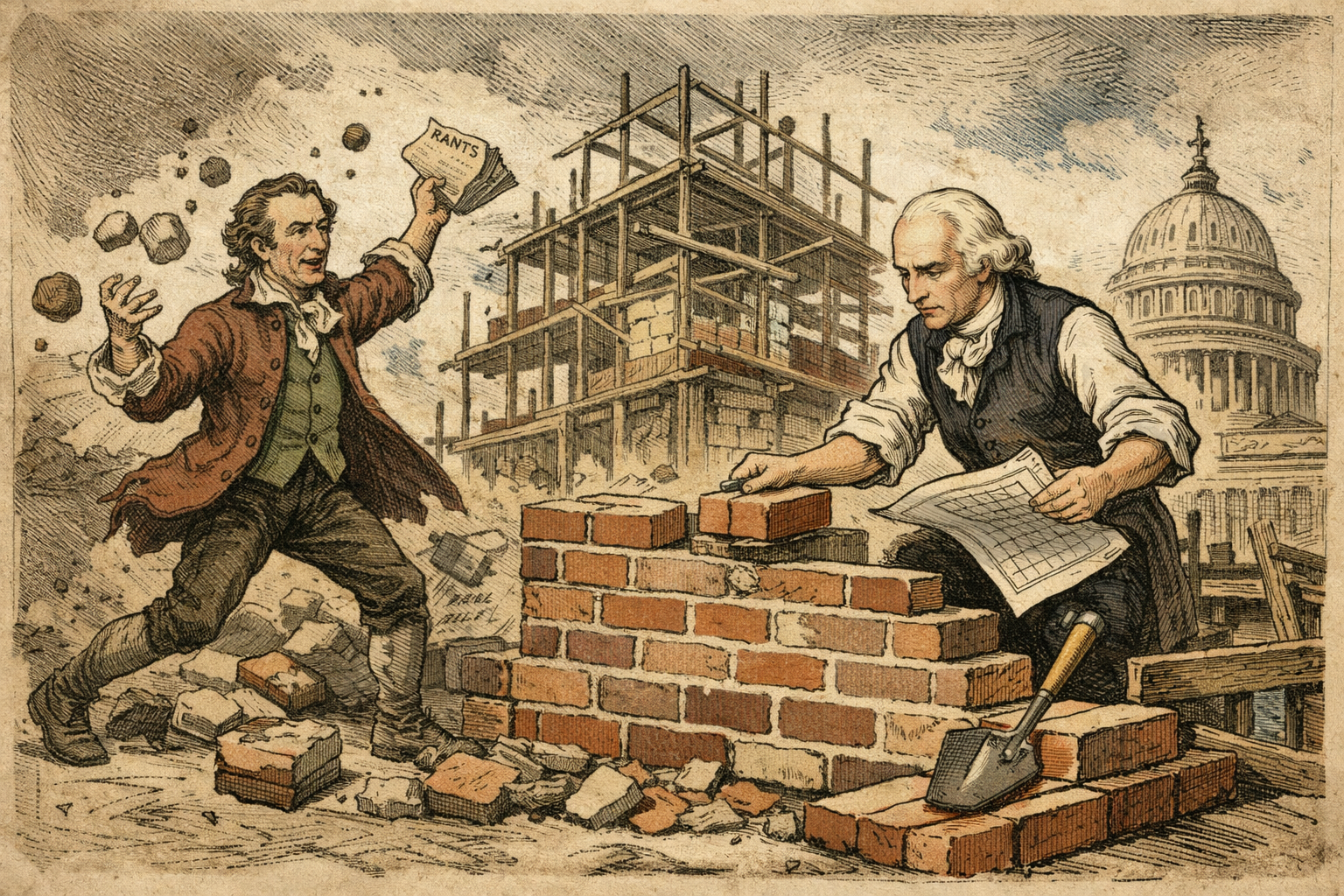
Madison, Paine, and the Discipline to Construct a Republic
Any fool can tear a house down. Gravity performs most of the work. Construction demands proportion, patience, and the willingness to accept that no structure rises under ideal conditions.
Politics rewards demolition.
Warped Minds is a reader-supported publication. To receive new posts and support my work, consider becoming a free or paid subscriber.
A well-aimed denunciation travels faster than a carefully drafted statute. A viral speech clip attracts more attention than a negotiated budget. The modern political marketplace amplifies the sharpest retort, the cleanest outrage, the most theatrical refusal. Stone-throwing scales. Brick-laying does not.
American history offers a revealing contrast in the lives of Thomas Paine and James Madison.
Paine threw stones that shook an empire. Madison laid bricks that still carry the weight of a continent.
In 1776, Paine’s Common Sense electrified colonial America. He wrote in language that bypassed elites and struck the ordinary reader with moral urgency. Monarchy was not merely inefficient. Monarchy was illegitimate. His sentences did not invite negotiation. They demanded rupture. Paine possessed the rare ability to transform scattered frustration into unified indignation. Independence required that fire.
Madison shared the revolutionary cause but not Paine’s temperament. Where Paine saw corruption that demanded demolition, Madison saw human nature that required structure. Paine trusted virtue once liberated. Madison distrusted virtue once empowered. The difference was not moral seriousness. The difference was institutional imagination.
After independence, the divergence sharpened. Paine continued to write against concentrated authority, attacking aristocracy in Britain, monarchy in Europe, and later organized religion itself. His instinct remained insurgent. He excelled at exposing illegitimacy. He did not root himself in the slow discipline of governance. He did not draft constitutional compromises, build legislative coalitions, or nurse fragile agreements through procedural conflict. His genius lay in ignition.
Madison entered the Constitutional Convention of 1787 as a student of failure. The Articles of Confederation had revealed the fragility of enthusiasm unbound by architecture. States quarreled. Credit faltered. Congress lacked coercive authority. Liberty, left unstructured, drifted toward disunion. Madison arrived in Philadelphia with research in hand and a theory formed through historical study. He understood that passion required containment if freedom was to endure. The extended republic, separation of powers, and multiplication of factions were not abstractions. They were load-bearing walls.
The Constitution bore compromise in its beams. Large states conceded to small states. Slave states bargained with free states. Executive power balanced legislative ambition. No clause satisfied purists. The document survived precisely because it was constructed under constraint. Madison did not celebrate friction. Madison designed it.
History produces pamphleteers more easily than architects. Revolutionary voices arise wherever grievance concentrates. Russia had Vladimir Lenin, whose writings and agitation dismantled an empire. Cuba had Che Guevara, whose image became synonymous with insurgency. France had Jean-Jacques Rousseau, whose suspicion of inherited authority stirred unrest long before the Bastille fell. Each revolution found its Paine. Each upheaval produced a voice capable of converting dissatisfaction into moral urgency.
Architects are rarer.
Revolution demands ignition. Republics demand calibration. Many societies have overthrown regimes. Fewer have constructed durable constitutional orders capable of absorbing ambition without collapsing into tyranny or fragmentation. The American founding generation produced both the incendiary pen of Paine and the institutional discipline of Madison. That pairing was not inevitable. It was exceptional.
Paine’s are common because indignation is common. Madison’s are scarce because restraint under power is uncommon. One talent rallies crowds. The other designs systems that can survive them.
The arc of the two men’s lives reveals the divergence. Paine died admired by later generations yet estranged from many contemporaries. His pen unsettled institutions on two continents. He left behind words that stirred consciences. Madison lived to see the Constitution tested, amended, and embedded into national life. He defended it in argument, stewarded it in office, and preserved it during war. Madison’s legacy does not reside in a single electrifying moment. It resides in a structure that continues to mediate ambition.
The tension between stone-thrower and builder persists in modern politics. Denunciation attracts applause. Coalition-building attracts suspicion. Permanent opposition feels morally pure. Governance feels compromised. A professional critic can remain perpetually unsullied by the imperfections of implementation. A builder must accept that every enacted policy bears fingerprints of concession.
A republic cannot operate in permanent demolition.
Breakthrough is an event. Architecture is a legacy. Over time, fewer citizens remember how many flaws a politician identified. Entire generations live within the consequences of the structures that politician helped construct.
Any fool can go viral.
Few can build a republic.
The choice arrives quietly in every political career and in every engaged citizen. One path offers applause without accountability. The other demands patience without guarantee of praise.
A republic must be constructed, maintained, and occasionally renovated. The stone-thrower commands the moment. The builder shapes the century.
Choose carefully which legacy to pursue.
Author’s Note:
ChatGPT assisted in drafting and refining this essay. The machine did not supply the convictions. It merely helped organize them. Any structural weaknesses are human.