

The Journey of a Lifelong Republican Who Stopped Policing Purity
I am a lifelong conservative and Republican.
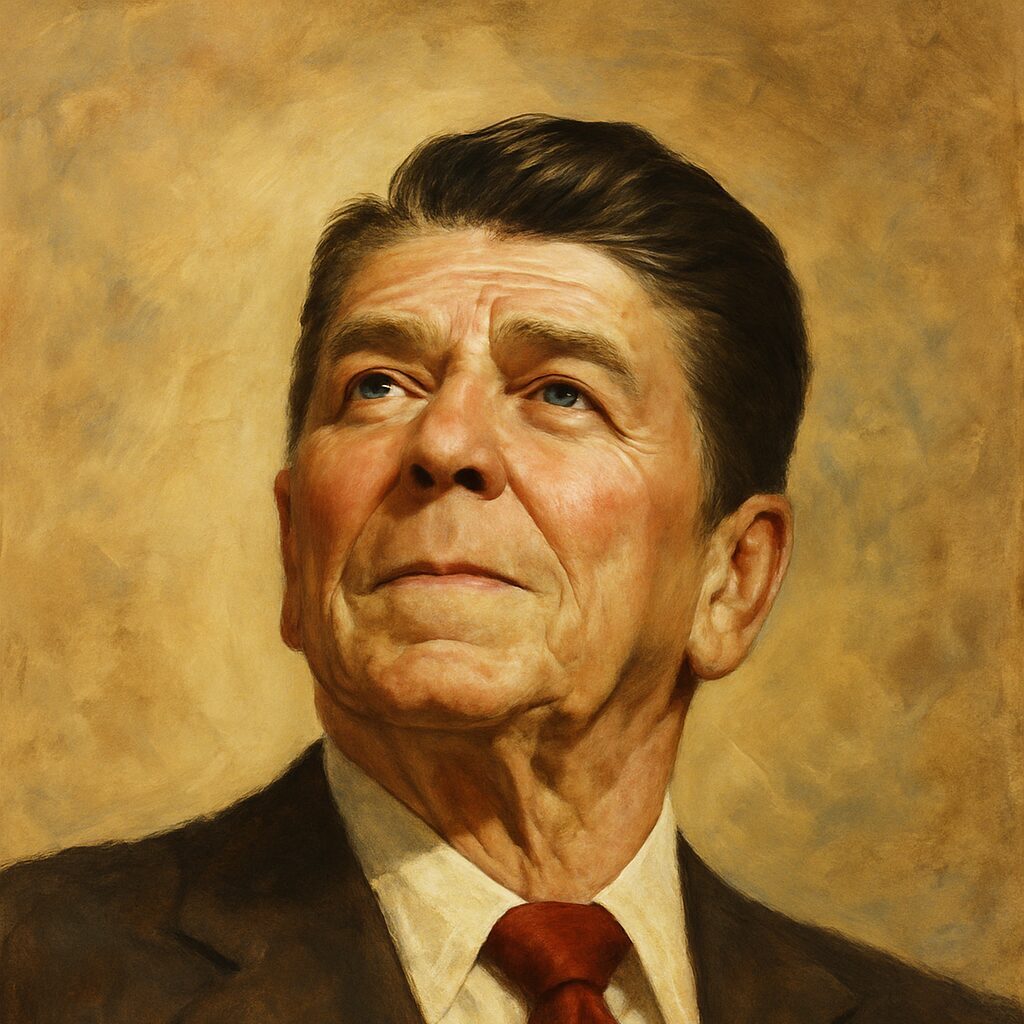
I have campaigned and door-knocked since before I can remember. I have rarely missed a primary vote—in nearly forty years of voting, I cannot recall skipping one, though I am sure I have. The habit of showing up runs deep. I grew up in a party that prided itself on ideas, optimism, and a certain measure of grace. Ronald Reagan once said,
“The person who agrees with you eighty percent of the time is a friend and an ally—not a twenty percent traitor.”
For most of my life, I have tried to live by that rule.
I first heard the word RINO—Republican In Name Only—when I was young, back in 1994. I was listening to Rush Limbaugh and following the Contract with America with the kind of zeal only a twenty-something could muster. I admired Newt Gingrich, campaigned for Fred Thompson and Bill Frist, and remember how both men shocked Tennessee by capturing the state’s two Senate seats in the same year. I even have a photo of myself with Senator John McCain, then a little-known senator from Arizona and a former Vietnam POW, stumping for Frist that season.
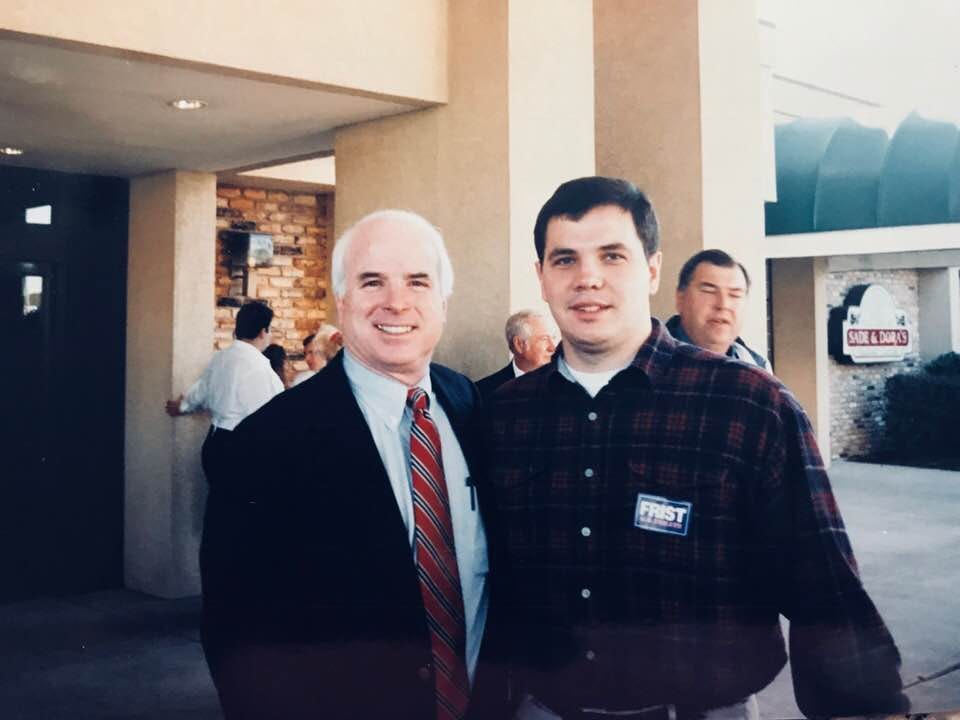
The author with Senator John McCain, circa 1994, during Bill Frist’s Senate campaign stop in Cookeville, Tennessee.
Those days were heady ones for conservatives. The party was bold, disciplined, and determined. We believed we were restoring balance to government. Back then, the term RINO sounded like a rallying cry for purity and principle—a way to defend conservatism from drift. Only years later did I realize how wrong that instinct could become.
A Short History of a Long Insult
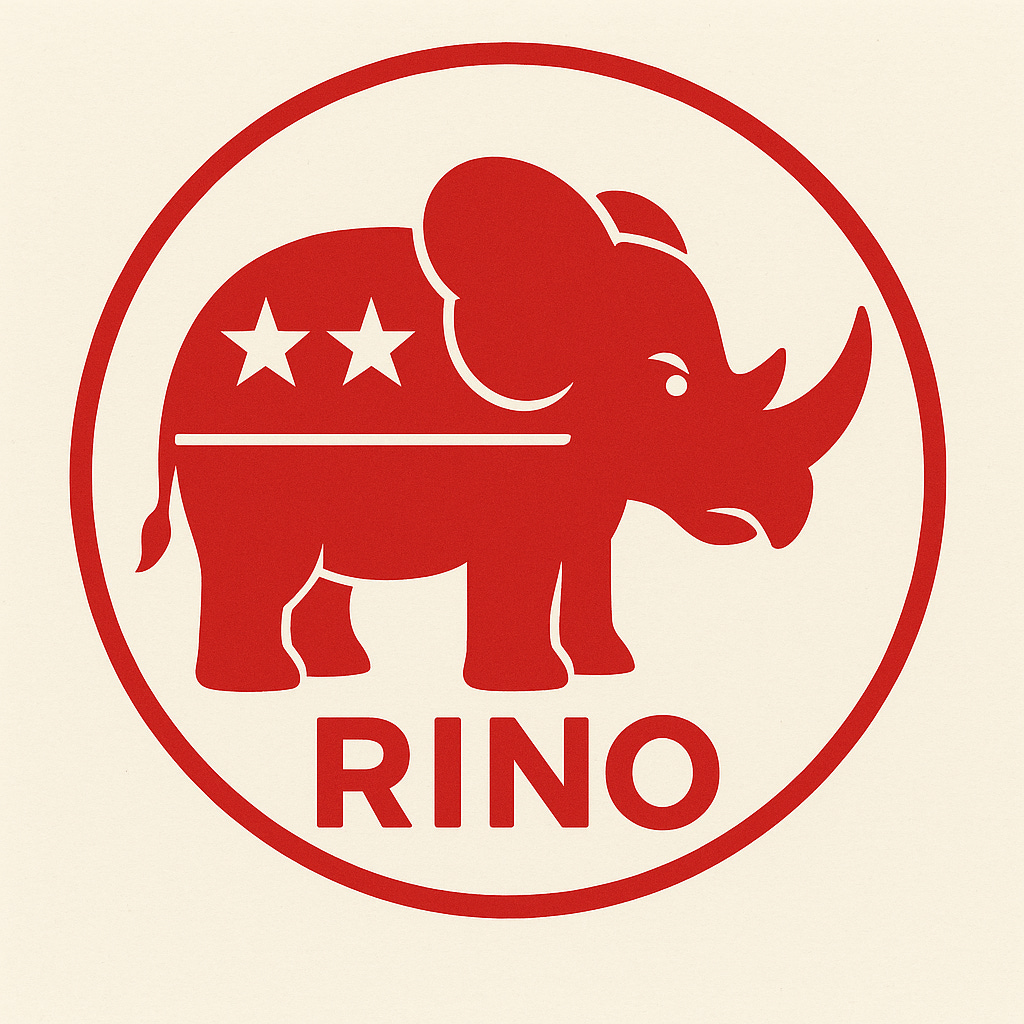
The phrase “Republican in name only” predates the 1990s by nearly a century. It appeared in the early 1900s, when progressives and traditionalists clashed during the Theodore Roosevelt era. But the acronym RINO, with its catchy rhyming punch, did not appear in print until around 1992, in a New Hampshire newspaper. Conservative activists soon printed the term on buttons—often with a cartoon rhinoceros—to mock moderates they saw as too willing to compromise.
At first, RINO was ideological. The acronym drew a line between conservative and centrist policy views. By the Trump era, however, the term has morphed from policy purity to personal loyalty. RINO no longer means “too liberal.” The label has come to mean “not loyal enough.” What began as a word about ideas became a weapon against people.
The Psychology Behind the Label
Psychologists have long understood that name-calling is a form of cognitive simplification. Faced with complexity, the human brain prefers shortcuts. We label rather than listen. We sort people into tribes—friend or foe, patriot or traitor, conservative or RINO—because it saves mental effort. Daniel Kahneman would call this mental laziness the triumph of the fast, emotional brain over the slow, deliberative one. The insult becomes a way to stop thinking. Once a person has been labeled, one no longer needs to consider what they actually said.
Calling someone a RINO, then, is an act of cognitive economy—but also of intellectual surrender. The label collapses the nuance of policy, principle, and conscience into a single moral verdict. And once that verdict is rendered, dialogue is over.
The Threat to Identity
The deeper reason we reach for labels like RINO lies in identity defense. Social identity theory shows that much of our self-worth comes from belonging to a group. When a fellow Republican voices disagreement, the attack can feel like a personal one. The label RINO becomes armor—a way to cast the other person out and reaffirm our own belonging. Yet a party built on exclusion rather than persuasion loses both breadth and depth.
The Republican Party I grew up with encouraged debate—over taxes, foreign policy, and the proper size of government. Those arguments sharpened our ideas. Today, the word RINO ends arguments before they begin. In my youth, I too was guilty of this transgression.
The Dehumanizing Turn
Albert Bandura’s research on moral disengagement shows how labeling people with demeaning terms strips away empathy. The word RINO implies betrayal. The label turns fellow citizens into heretics. Once someone is cast as “not one of us,” the moral distance widens. We stop listening and start purging. Each insult feels righteous in the moment, but quietly corrodes the foundation of shared respect that movements require.
The Performative Reward
Name-calling also endures because the act feels rewarding. Insults act as dominance signals—they show loyalty to the tribe. In today’s social media environment, outrage gets clicks and applause. Calling someone a RINO earns social currency. But dominance displays are not deliberation. They are theater. They replace persuasion with performance and reason with ridicule. Reagan’s eighty-percent friend becomes a twenty-percent enemy, and unity becomes uniformity.
The Mirror Effect
Psychologists note that name-calling often reveals more about the speaker than the target. Freud called this effect projection; modern researchers call it self-concept maintenance. When we feel uncertain about our own standing, we accuse others of impurity. That reason is why movements built on purity tests tend to consume themselves. The French Revolution learned that lesson. So have more than a few political coalitions that forgot the value of dissent. A movement that eats its own is a movement that has lost its purpose.
The Cost to Deliberation
When name-calling becomes normal, deliberation becomes impossible. The essential precondition for democratic discussion is reciprocity—the belief that one’s opponent might also be reasonable. Without that belief, debate devolves into war by other means.
In that sense, RINO is more than a rude word; the term is a betrayal of republican ethics. The name violates the principle of argument within unity—the very principle that sustains both the Party and the Republic. If we cannot tolerate dissent within our own ranks, how can we hope to govern a nation of differences?
Toward a Better Habit
The antidote is not silence. Politics requires conviction. But conviction should not come at the expense of curiosity. The real test of leadership is whether we can hear an argument we dislike and still try to understand the disagreement. That ability is the essence of deliberation—and the foundation of compromise.
To live up to Reagan’s standard, we must recover the discipline of description over denigration. Ask what someone believes before deciding who they are. Disagree firmly, but not contemptuously. A coalition, by definition, contains difference. The measure of a party’s strength is not how perfectly it purges dissent, but how intelligently it integrates it.
In Sum
After four decades of campaigning, voting, and arguing within my own party, I have learned that the term RINO serves no one well. It was born in a moment of division and has become a tool of exclusion. Reagan understood something profound when he urged Republicans never to speak ill of one another. He was not calling for politeness. He was calling for courage—the courage to deliberate without demeaning, to differ without dehumanizing, and to recognize that unity without uniformity is the truest test of strength.
We can disagree passionately. We can fight for principles. But we cannot keep calling one another RINOs and expect to remain a party—or a republic—worthy of the name.
Reagan’s wisdom on this point was not just tactical; it was moral. He called it his Eleventh Commandment:
“Thou shalt not speak ill of any fellow Republican.”
That commandment was never about suppressing dissent. The commandment was about sustaining trust. The same trust our Republic still depends on today.
Author’s Note: This essay was written with the help of ChatGPT, my AI research partner, whose silicon neurons occasionally help me untangle the human ones.
