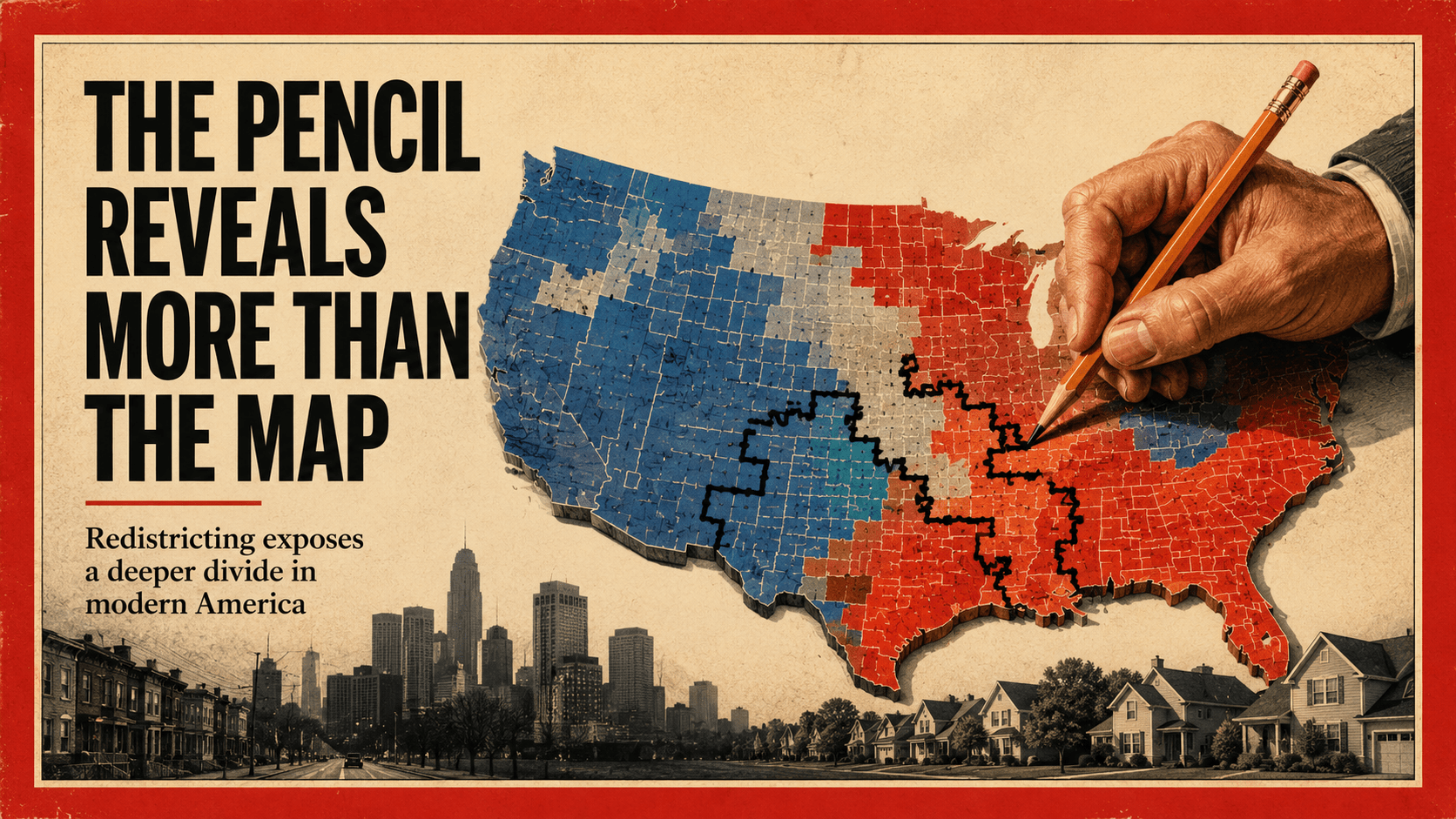
The recent political battles over congressional districts reveal something deeper about the structure of American society than about the politicians drawing the maps.
This week, the NAACP launched an “Out of Bounds” campaign urging Black athletes and fans to reconsider participation in public universities across several Southern states over voting-rights and redistricting disputes. Associated Press coverage of the controversy quickly spilled into college athletics and the broader culture war.
The modern NCAA increasingly wanders into political controversies far removed from basketball courts and football fields. Whether the organization applies those standards consistently—or, more likely, inconsistently—across issues remains a debate for another day. The more interesting question concerns what the controversy reveals about America itself.
The deeper issue concerns what modern district maps reveal about the nation itself.
Race and partisan affiliation increasingly sort geographically in modern America. In many places, a person can draw lines across a map that reliably separate Black and white neighborhoods, Republican and Democrat voting blocs, affluent suburbs, and struggling urban cores. The lines often emerge with disturbing ease.
That reality should trouble Americans far more than the mechanics of redistricting alone.
Martin Luther King Jr. once dreamed aloud of a nation composed of “black men and white men, Jews and Gentiles, Protestants and Catholics” living together as fellow citizens rather than separate camps. America historically contained deep disagreements over religion, ethnicity, class, and culture, yet many of those divisions remained intermixed inside neighborhoods, schools, workplaces, churches, and civic institutions.
America historically contained bitter divisions between Jews and Gentiles, Protestants and Catholics, yet many of those differences remained intermixed inside the same neighborhoods, schools, workplaces, and civic institutions. Modern racial and partisan sorting increasingly produces cleaner geographic separation than earlier generations would have recognized.
Could someone easily draw clean geographic boundaries between Jews and Gentiles, Protestants and Catholics?
The question matters because healthy republics depend upon civic mixing. A stable republic forces citizens with different beliefs, backgrounds, and traditions to encounter one another regularly enough to remain neighbors despite disagreement.
Modern America increasingly moves in the opposite direction.
Citizens sort themselves geographically, culturally, educationally, economically, and politically all at once. Neighborhoods increasingly reflect voting behavior. Voting behavior increasingly reflects identity. Identity increasingly hardens into moral suspicion.
The result appears on the map.
Gerrymandering certainly exists. Political actors have manipulated district boundaries for generations. Yet a society that can be sorted with remarkable precision already contains deep clustering before the first line is drawn.
The pencil exposes the fracture.
The pencil did not necessarily create the fracture.
Race itself often reflects the same misunderstanding. Americans increasingly speak about race as though skin color represents a deep and immutable biological boundary separating human beings into distinct camps. I explored that problem previously through a simple illustration using M&M candies and genetics in an earlier essay: The M&M Fallacy: What Candy Teaches Us About Race and Genetics
James Madison worried constantly about faction. Federalist No. 10 warned that democratic societies naturally divide into competing groups driven by passion, economics, religion, and identity. Madison hoped that a large republic would diffuse those factions across a vast nation, forcing Americans into overlapping coalitions rather than hardened tribal camps.
Modern technology increasingly works against that diffusion. Social media, nationalized news, and self-sorting communities allow citizens to cluster more tightly than earlier generations could have imagined.
Perhaps the deeper tragedy concerns not merely politics but the disappearance of shared civic spaces where Americans once mingled despite their disagreements.
College athletics never stood fully apart from America’s racial divisions. Many programs remained segregated deep into the twentieth century. Yet competitive success gradually forced forms of integration and cooperation that politics often resisted. Winning ultimately depended upon talent, discipline, teamwork, and performance more than tribe or ideology. In some places, locker rooms integrated more successfully than politics did.
Perhaps the NCAA should think carefully before pulling college sports further into the gravitational pull of America’s political and racial tribalism. A nation already struggling to live together benefits from preserving at least a few arenas where success still depends primarily upon talent, discipline, teamwork, and the content of one’s character.
AI Disclosure: This article was developed with the assistance of artificial intelligence tools used for research support, editing, and drafting. Final arguments, opinions, and editorial judgment remain my own.