Why We Celebrate the Declaration but Neglect the Constitution
As America approaches the 250th anniversary of the Declaration of Independence, the nation will rightly turn toward July 4, 1776. There will be fireworks, flags, speeches, parades, cookouts, patriotic music, and countless reflections on what America means. The Declaration deserves that honor. Few political documents have spoken with such moral clarity or inspired so many people across so many generations.
The Declaration gave America her birth certificate and her creed—the words still thunder: life, liberty, and the pursuit of happiness. The document announced that government exists to secure rights, not to grant them. The Declaration also gave Americans a story simple enough for children to understand and profound enough for adults to spend a lifetime trying to live up to.
But the coming anniversary raises another question. Why do Americans celebrate the Declaration with such passion while giving far less attention to the Constitution? The Constitution may be the more important governing document. The Declaration announced independence. The Constitution made self-government possible. The Declaration broke the colonies away from Britain. The Constitution built the framework that allowed a fragile collection of states to become a durable republic.
July 4 lives in the national imagination. September 17 barely whispers. That contrast may tell us something important about our country, our politics, and our difficulty honoring compromise.
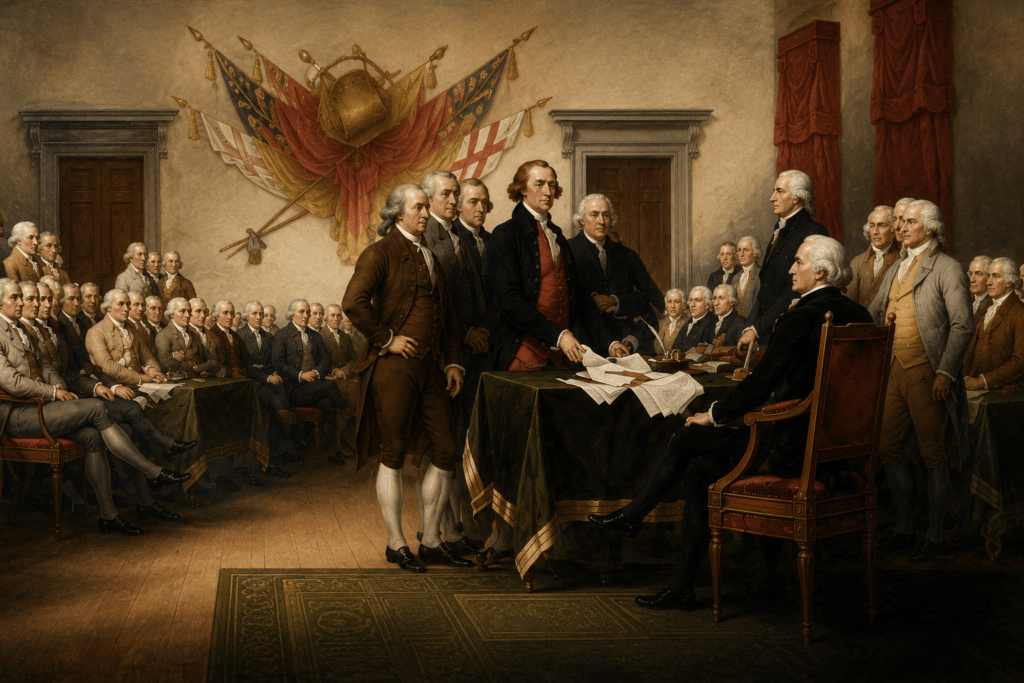
What day do we commemorate with this picture?
Most readers know the answer immediately: July 4, Independence Day. The scene carries drama even before anyone studies the details. Men in colonial dress gather in a room. A document rests before them. A people stand at the edge of revolution. A new nation prepares to speak.
The image feels heroic because the story feels clear. Tyranny stands on one side. Liberty stands on the other. A distant king has violated the rights of the people. The colonists, after years of petitions and grievances, declare that separation has become necessary. The Declaration gives Americans a dramatic beginning, and nations remember dramatic beginnings.
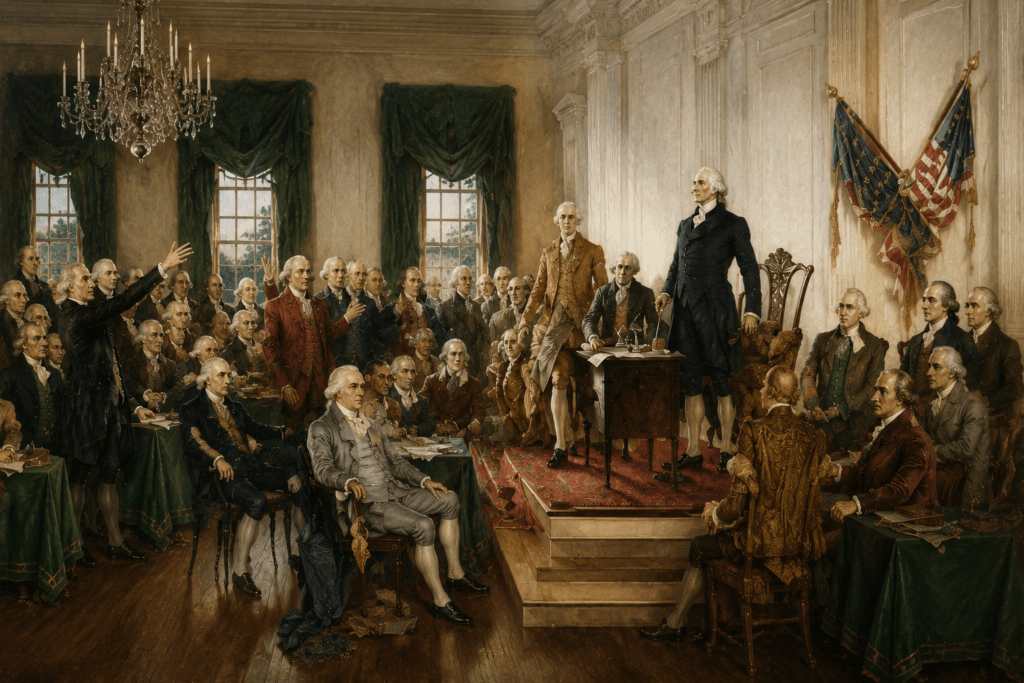
What day do we commemorate with this picture?
Here is where many readers pause. I paused too. I knew the Convention, Philadelphia, Madison, Washington, Franklin, Hamilton, and the long summer of 1787. I knew the Constitution came through debate, secrecy, conflict, and compromise. But the commemorative date did not live in my bones the way July 4 lives in my bones.
September 17, 1787, marks the signing of the Constitution. No shame belongs to any reader who did not know that date. Many patriotic Americans, educated Americans, and historically curious Americans know July 4 without knowing September 17. The gap deserves attention, not because Americans love the Declaration too much, but because Americans may love the Constitution too little.
Two Founding Moments, Two Different Lessons
One picture announces a revolution. The other picture assembles a system. The Declaration declares independence from a distant king. The Constitution creates a government strong enough to survive human nature at home. The Declaration offers a clean moral drama. The Constitution offers structure, procedure, representation, federalism, separated powers, amendment, ratification, and restraint.
No fireworks naturally spring from the Connecticut Compromise. No parade route forms around bicameralism. No patriotic song easily rhymes with enumerated powers. Yet those dry constitutional features helped make American liberty durable. A people may declare liberty in a moment of courage, but a people preserve liberty through habits, institutions, and discipline.
The Declaration inspires because it sounds like poetry. The Constitution endures because it works more like architecture. Poetry can move the soul in a moment. Architecture keeps the roof from collapsing over generations. A serious nation needs both.
Why July 4 Lives in the Heart
The Declaration gives Americans nearly everything a national celebration needs: a clear date, a simple story, a villain, a heroic break, a moral claim, and a short list of immortal phrases. Before July 4, the colonies. After July 4, the nation. History was more complicated than that simple formula, but national memory rarely operates like a footnote.
John Adams understood the emotional power almost immediately, even though he expected July 2 to become the great anniversary because Congress voted for independence on that date. Adams predicted that independence would be celebrated with pomp, parade, bells, bonfires, and illuminations. History chose July 4 instead, but Adams correctly understood the human heart. Freedom needs festivals. A free people need moments when gratitude becomes public.
The Constitution entered American life through a different door. No single dramatic break defines the Constitution. No king serves as the obvious villain. No list of grievances carries the reader toward revolution. The Constitution begins magnificently with “We the People,” but the document quickly turns toward legislative powers, executive duties, judicial jurisdiction, elections, terms, treason, amendments, and ratification. The Declaration reads like a trumpet blast. The Constitution reads like a blueprint.
Blueprints matter. Blueprints hold the house together. Blueprints make the inspiring speech possible. But blueprints rarely make people cry. Blueprints are boring.
Why Compromise Is Harder to Celebrate
The Constitution also came from disappointment. The delegates gathered in Philadelphia because the Articles of Confederation had proven inadequate. The young nation faced debt, weakness, interstate conflict, and the possibility that the Revolution had created independence without creating a workable government. The delegates came to repair a broken system, and repair work rarely becomes romantic.
The Convention also happened behind closed doors. Secrecy allowed candor. Secrecy allowed delegates to change their minds. Secrecy allowed political leaders to negotiate without every half-formed thought becoming a public accusation. But secrecy also deprived later generations of a simple public drama. The Declaration could be read aloud to crowds. The Constitution had to be defended, ratified, amended, and brought into existence.
A deeper reason may explain the silence around September 17. Americans are better at celebrating radical declarations than constitutional compromises. The Declaration represents a radical act against the most powerful empire on earth. The Constitution represents a different kind of courage: the courage to sit in a room with people who disagree, lose some arguments, accept half a loaf, and build something no one loved perfectly because the alternative might be failure.
Compromise rarely inspires passion in the same way revolution inspires passion. A radical declaration can be shouted. A compromise must be explained. A radical position says, “I am right.” A compromise says, “I may be right, but I still have to govern with people who disagree with me.”
That truth stands near the center of everything I have been trying to argue in my books and essays. Free societies do not survive merely because citizens know how to make demands. Free societies survive because citizens know how to govern together after making those demands. Democracy gives people a voice. A republic teaches people how to use that voice without destroying the common home.
The Founders Were Not All Satisfied
Modern Americans sometimes imagine the Founding as a clean agreement among giants. The actual Founding was messier. The Constitution contained deep conflicts over representation, state power, national power, executive authority, commerce, taxation, and slavery. Some delegates left before the Convention ended. Some refused to sign. Some supported the Constitution only because failure seemed worse.
Benjamin Franklin captured the mood near the end of the Convention. Franklin admitted that he did not approve of every part of the Constitution, but he supported the document because he doubted any better one could be produced under the circumstances. That statement lacks the soaring romance of the Declaration, but Franklin’s humility may contain the wisdom necessary for republican government.
No constitution for free people can be the private wish list of one faction. No durable republic can be built entirely from the passions of one moment. No self-governing people can expect total victory and still expect union. The Constitution survived because the framers accepted something less than perfection. The Constitution survived because ratifiers argued, amended, and consented. The Constitution survived because liberty requires both aspiration and restraint.
The Promise and the Practice
The Declaration and Constitution should not be placed in competition. America needs both documents. The Declaration announces the promise. The Constitution provides the practice. The Declaration says human beings possess rights. The Constitution creates institutions capable of protecting rights. The Declaration says government derives just powers from the consent of the governed. The Constitution defines how consent will be organized, filtered, checked, balanced, and renewed.
The Declaration speaks to the soul. The Constitution disciplines the will. That discipline may explain why Americans find the Constitution harder to celebrate. The Constitution asks more of us. The Constitution asks winners to accept limits and losers to accept legitimacy. The Constitution asks factions to become majorities, majorities to respect minorities, and all sides to remain loyal to a system that will not always give them what they want.
July 4 deserves the fireworks. The Declaration of Independence gave America a moral inheritance that still challenges every generation. But after the fireworks fade, another founding date waits quietly on the calendar: September 17, Constitution Day.
A Declaration can announce liberty. Only a Constitution can help a free people keep liberty. Maybe Americans celebrate July 4 because radical declarations stir the blood. Maybe Americans neglect September 17 because compromise demands maturity. But a republic cannot survive on inspiration alone. A republic also requires restraint, structure, patience, and the humility to govern with people who do not see the world exactly as we do.
The Declaration gave America her poetry. The Constitution gave America her discipline. As America celebrates 250 years of independence, perhaps the best tribute to the Declaration would be to remember the Constitution, too. Liberty may begin with a declaration, but liberty endures through compromise.
“When I Became a Man”
As a child, I celebrated Jefferson and the Declaration of Independence. That made sense. The Declaration speaks to the young heart. The Declaration is bold, brave, defiant, and inspiring. The Declaration says that liberty matters enough to risk everything.
But after more than fifty years of living, learning, arguing, voting, losing, winning, compromising, and watching our republic strain under the weight of its own passions, I find myself appreciating Madison and the Constitution more and more. That shift does not diminish Jefferson. The poetry of the Declaration still matters. But age has taught me to value the architecture that allows liberty to endure.
The young man in me still loves Jefferson’s poetry.
The older man in me has learned to cherish Madison’s architecture.
AI disclosure:
This essay was written with assistance from artificial intelligence. The argument, interpretation, historical judgment, and final responsibility for the content are my own.