Modern primaries have turned candidates into parties of one—and formal parties into labels they no longer control.
What does a modern candidate need a political party for?
Knox County offers a clear example, but the problem reaches far beyond East Tennessee.
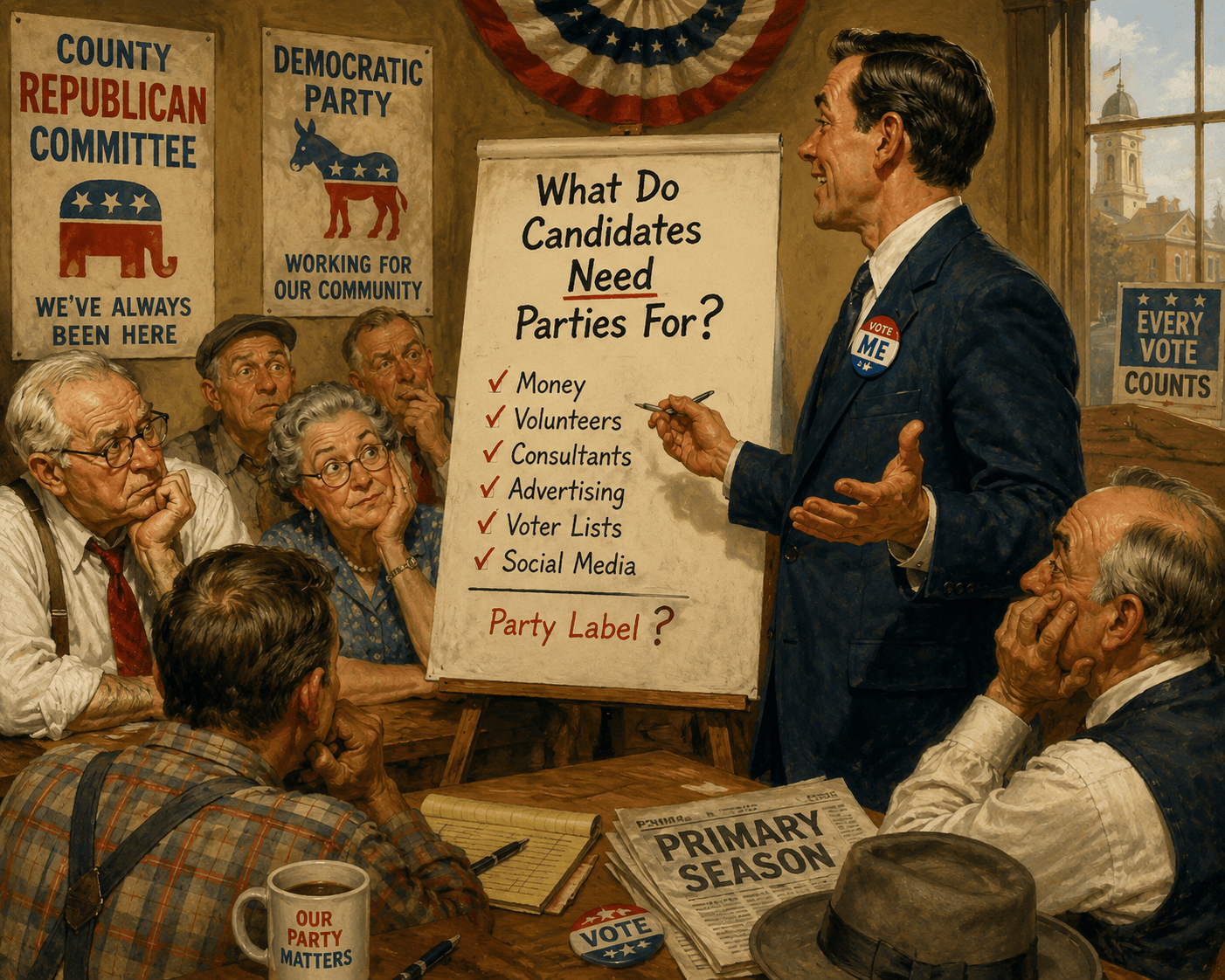
To win a primary, a candidate forms a committee, hires consultants, raises money, recruits volunteers, builds a voter list, buys advertising, knocks on doors, and creates a social-media following. Donors, political action committees, advocacy groups, and elected officials may join the effort.
Yet, perhaps surprisingly, the official party may contribute little to any of it.
Each serious candidate, in effect, builds a temporary political party with its own money, workers, message, strategy, and loyalties. Then the candidate wins the primary and becomes the party’s nominee.
But the campaign does not become the party. Instead, the party inherits a nominee it may not have recruited, reviewed, trained, funded, or supported.
What did the party provide?
Often, little more than its name.
That name has great value. An R or D beside a candidate’s name carries decades of loyalty. It tells voters something about the candidate’s likely principles and priorities. Many people vote for the label even when they know little about the person.
The modern primary did not eliminate political parties. It separated the party label from the party organization.
A Brand Without a Supply Chain
Modern parties resemble companies that kept their trademarks but lost control of their supply chains.
A local party may not recruit candidates, examine their backgrounds, test their judgment, train them, help them raise early money, or supply volunteers. Yet one candidate eventually receives the party’s most valuable asset: its name—its brand.
Political scientists Daniel Schlozman and Sam Rosenfeld call today’s major parties “hollow parties.” The parties remain powerful as voter identities, but much of their work has moved to candidates, consultants, donors, interest groups, and outside networks.
The party remains responsible for the product, even though it did not design, test, or build it.
Primaries Solved a Real Problem
With that said, we should not romanticize the old system—the system of party bosses and political machines.
Party bosses could be corrupt, closed, and unaccountable. Machines protected insiders and sometimes denied voters a real voice. Reformers promoted direct primaries to weaken those machines and open nominations to the public.
That reform gave voters more power. Over time, party leaders lost much of their formal authority while primary voters became the accepted source of a nominee’s legitimacy.
The change also split power from responsibility.
Primary voters choose the nominee. The candidate runs the campaign. Outside groups provide much of the money and labor. But the formal party receives the praise or blame for what the nominee says and does.
Authority went one way. Responsibility went another.
Why Would Candidates Owe the Party?
Party leaders often complain that candidates vanish after elections. They stop visiting clubs, ignore volunteers, neglect the platform, and govern without consulting the people who maintain the organization.
But what created the obligation?
The candidate raised the money, recruited the volunteers, hired the consultants, built the message, contacted voters, and survived the attacks. The party may have stood on the sidelines through the entire contest.
After winning alone, the nominee may decide the party needs the candidate more than the candidate needs the party.
Loyalty cannot rest on sentiment. It grows from shared work, mutual support, and reciprocal obligation.
A candidate who receives only a ballot label will feel stronger loyalty to those who provided real help: donors, consultants, campaign workers, endorsers, and factional groups. They become the candidate’s true political home.
Power did not disappear when formal parties weakened. It moved elsewhere—often to groups less transparent, less rooted in the community, and less responsible for governing after Election Day.
What Should a Party Provide?
A working party should offer more than a letter beside a name.
It should recruit promising citizens before they declare. It should conduct confidential background reviews, test judgment, train candidates to campaign, and prepare them to govern. It should connect them with clubs, donors, volunteers, community leaders, and experienced officeholders.
A party should also set clear standards for endorsements. Candidates who meet those standards should receive real help: training, professional advice, fundraising support, volunteers, voter data, and public backing.
Voters should still make the final choice. Restoring a role for the party does not require smoke-filled rooms or political bosses. Party experience can supplement primary voters’ judgment, especially when assessing competence, coalition-building, and readiness to govern.
A healthy party must work before the primary and accept responsibility after it.
The goal is not control. The goal is stewardship.
Loyalty Must Run Both Ways
A stronger party would create a compact with its candidates.
Candidates would submit for review, participate in training, support local clubs, help fellow nominees, and remain engaged after the election. In return, the party would invest money, time, people, knowledge, and reputation in them.
The candidate would need the party. The party would have earned the candidate’s loyalty.
Political parties should do more than place trademarks on independently built campaigns. They should recruit leaders, develop talent, assemble coalitions, win elections, and help nominees govern.
Before a party demands loyalty, it must become worthy of loyalty.
A party that contributes only its label should not be surprised when its nominees treat it as nothing more than a label.
AI Disclaimer: No artificial intelligences were elected to public office during the writing of this essay. ChatGPT helped me tighten the prose and challenge my thinking. Any errors, questionable analogies, or political heresies remain proudly my own.