How Primary Reform Changed the Meaning of Losing
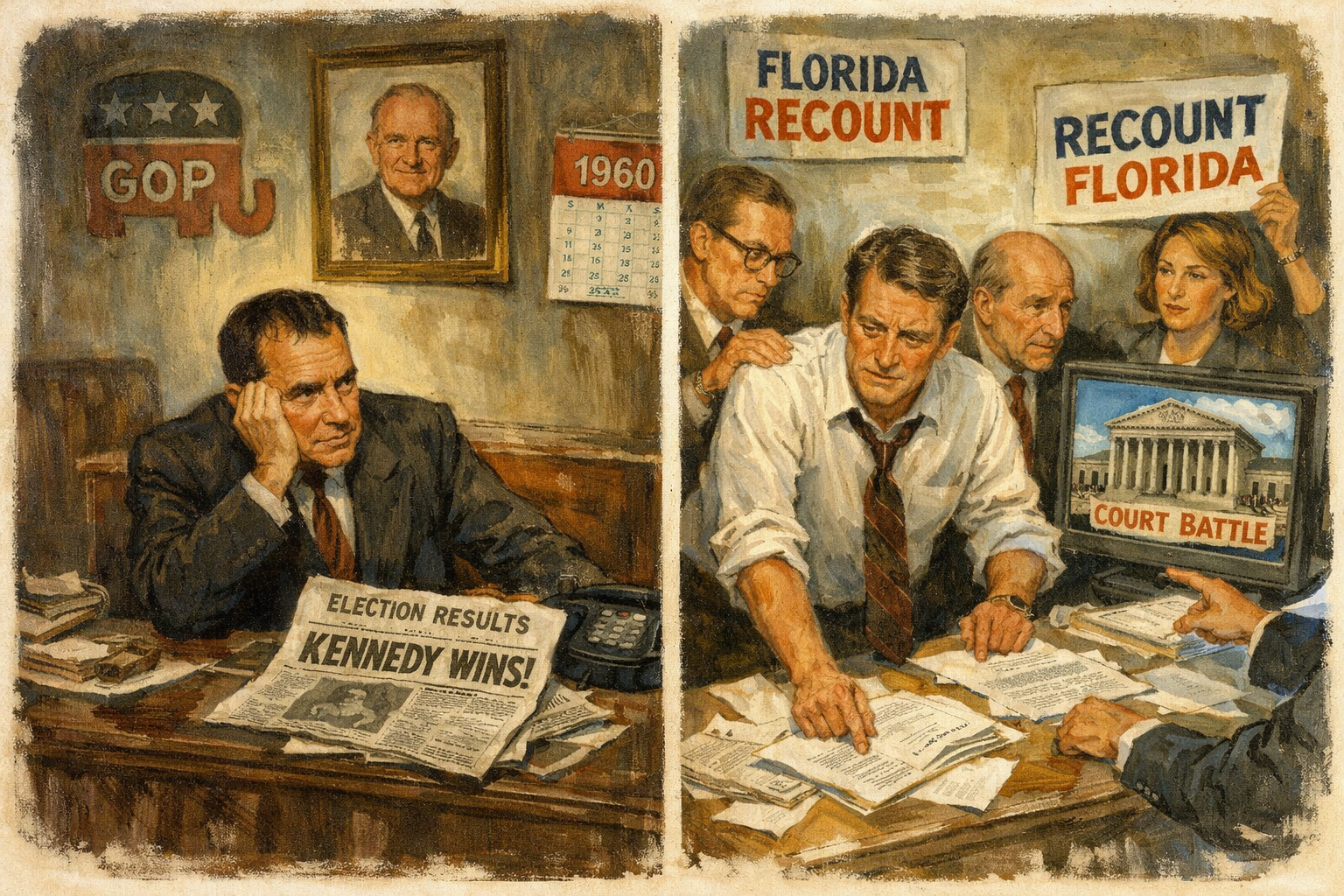
Two of the closest presidential elections in American history ended very differently. In 1960, Richard Nixon stepped aside. In 2000, Al Gore went to court. Was one man nobler than the other—or did the structure of American democracy itself change the incentives for how defeat is handled?
The Kennedy–Nixon election of 1960 was exceptionally close. Fewer than 120,000 votes separated the candidates nationwide. Allegations of irregularities surfaced almost immediately, particularly in Illinois and Texas. In Chicago, turnout figures raised eyebrows. In downstate precincts, vote totals shifted late. In Texas, the presence of a powerful political machine only deepened suspicion. The factual basis for contestation was not imaginary.
Yet Nixon declined to pursue extensive legal challenges. He later explained that prolonged litigation risked a constitutional crisis and lasting damage to public confidence in the presidency. That explanation is often treated as evidence of personal restraint or civic virtue. The explanation is incomplete. Nixon’s decision also reflected the incentives of a party-centered political system that still existed in 1960.
Mid-twentieth-century political parties functioned as mediating institutions. Party elites screened candidates, absorbed losses, and preserved reputations over time. Losing a close election did not terminate a political career. Defeat could be understood as contingent rather than disqualifying. The party, not the candidate alone, carried political legitimacy forward. Nixon’s restraint did not end his prospects. Eight years later, the same party would nominate him again and deliver him the presidency.
Between Nixon’s loss and Gore’s, that institutional architecture changed fundamentally.
The reforms that followed the 1968 election—often grouped under the McGovern–Fraser Commission—sought to democratize presidential nominations. Party control over delegate selection weakened. Binding primaries expanded. Candidate-centered fundraising and campaign organizations replaced party committees as the engine of nomination politics. These reforms succeeded in opening the system to broader participation. They also altered where political legitimacy resided.
Under the pre-1968 system, legitimacy flowed through institutions. Afterward, legitimacy flowed directly from mass participation. Candidates no longer borrowed authority from parties. Candidates constructed personal coalitions, personal donor networks, and personal brands. Victory validated the candidate. Loss, increasingly, repudiated the candidate.
That shift collapsed what earlier parties had provided: reputational buffering. Under the old system, a narrow defeat could be survived because party elites retained discretion over future nominations. Under the new system, defeat became harder to reinterpret. Candidates who accepted loss risked conceding the very legitimacy that sustained their political standing.
The disputed election of 2000 unfolded entirely within this post-reform environment. The Florida recount was not merely a procedural controversy. The Florida recount became a referendum on personal legitimacy. In that context, contestation was no longer exceptional. Contestation became rational.
By the end of the twentieth century, election law had also evolved into a robust and contested legal domain. Campaigns anticipated litigation as a normal extension of electoral competition. Courts increasingly functioned as arbiters of political finality once party mediation disappeared. When the Bush–Gore contest reached the judiciary, it followed a path that institutional incentives had already prepared.
This contrast does not require moral judgment. Nixon’s restraint and Gore’s litigation do not reveal superior or inferior character. The contrast reveals how institutional design shapes behavior. Systems reward what they normalize. When parties provided pathways for recovery after defeat, patience made sense. When parties lost that role, litigation filled the void.
James Madison warned that unchecked factions would pursue advantage wherever opportunity arose once normal mediation failed. The irony is that political parties—once feared as dangerous factions—evolved into stabilizing intermediaries that absorbed ambition and softened loss. The post-1968 reforms weakened that stabilizing function in the name of democratic responsiveness. The reforms succeeded in expanding participation. They also narrowed the avenues for graceful defeat.
The lesson is not that legal challenges are illegitimate. The lesson is that systems requiring constant adjudication have already lost something more fundamental. A durable republic depends on institutions capable of translating narrow defeat into future opportunity. When those institutions erode, courts become the last refuge of legitimacy.
Nixon could afford to wait because the system gave him time. Gore could not afford to wait because the system no longer did. The difference was not altruism. The difference was architecture.