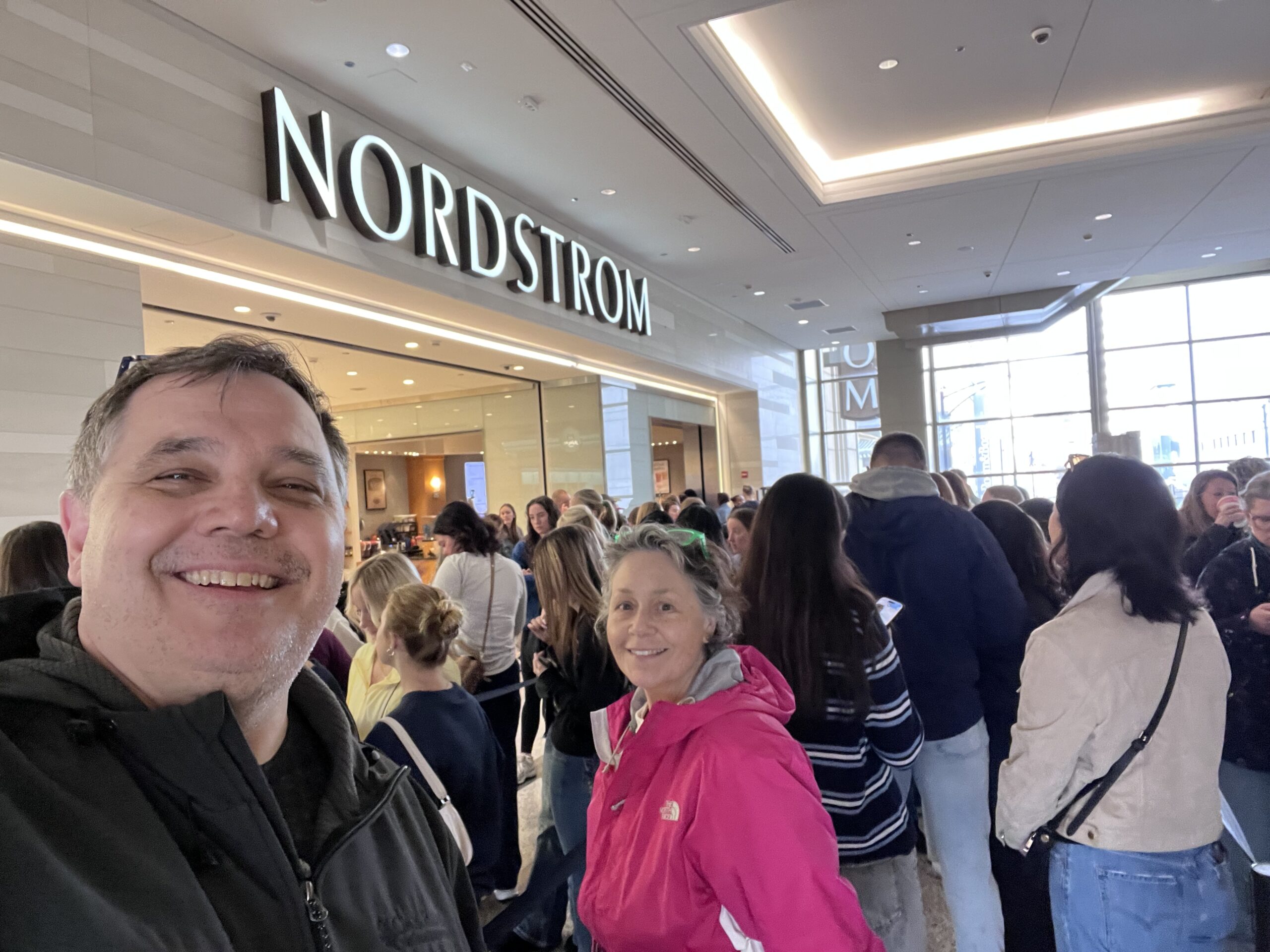
I did not know what JellyCat was.
Lisa did.
That was enough.
So we stood in line for an hour and a half inside a Nordstrom, waiting to enter a pop-up store filled with plush animals I could not have named ten minutes earlier.
From a purely transactional standpoint, the situation made no sense.
Any object inside that store could be ordered online. Delivered to the front door. No waiting. No crowd.
That framing misses the point entirely.
The People in the Line
In front of us stood a mother and her teenage daughter. She was a physician from Durham, North Carolina, visiting her older daughter in college. Behind us stood another mother and daughter, down from Florida for a volleyball tournament.
None of us were from Chicago.
None of us needed to be in that line.
Yet there we were—talking, laughing, trading stories about families, travel, school, and work. Ninety minutes passed faster than most dinners.
The line was not an obstacle to the experience.
The line was the experience.
The Interruption
About halfway through, a woman walking by stopped and asked the obvious question:
“What are you all standing in line for?”
We told her.
Her response came quickly, almost reflexively:
“I would never stand in line for something you could just order online.”
The tone was not cruel. Not aggressive. Not even particularly rude in intent.
But the statement carried a quiet implication:
I would not do what you are doing.
And just beneath that:
I make better choices than this.
A Small Jab
I told her the experience mattered more than the object.
She did not quite accept that.
So I asked:
“Did you order your husband online? Or was it more important to share experiences first?”
The analogy took a second to land.
Then it did.
She smiled, nodded slightly, and moved on.
Back in the line, the six of us—three families who had met ninety minutes earlier—had something new to laugh about.

What Happened There?
That moment has a name, even if most people have never studied it.
Sociologists like Pierre Bourdieu describe a process called distinction—the quiet ways people separate themselves from behaviors they consider beneath them, inefficient, or irrational.
Psychologist Leon Festinger would recognize another layer. When someone who values efficiency encounters people who willingly spend ninety minutes in a line for enjoyment, a tension forms:
“Am I missing something…or are they?”
The easiest resolution is dismissal.
“I would never do that.”
Say it out loud, and the identity locks in place.
Then there is the simple matter of comparison. Humans constantly measure themselves against others. Not always consciously. Not always fairly. But consistently.
“I would not do that” becomes a small, everyday way of saying:
“I am doing life a little better.”
What the Research Misses
There is a body of work—often associated with Thomas Gilovich—showing that experiences tend to produce more lasting satisfaction than material purchases.
That research is correct.
But the research does not capture the full texture of a moment like that line.
The research does not see the physician from Durham laughing with a stranger from Tennessee.
The research does not hear a teenager from Florida talking about her volleyball tournament with someone she met twenty minutes earlier.
The research does not measure the shared glance between a husband and wife who both know, without saying it, that the line was never really about stuffed animals.
The Quiet Arrogance of Efficiency
Efficiency is a powerful value.
Civilization depends on it.
But efficiency, when elevated above experience, begins to flatten life into transactions.
Click. Ship. Deliver.
Done.
No friction. No waiting. No inconvenience.
Also—no stories.
The woman who would “never stand in line” was not wrong in a technical sense.
She was wrong in a human one.

The Line as a Choice
Standing in that line was not irrational.
Standing in that line was a choice to value:
- Time spent together over time saved
- Conversation over convenience
- Experience over acquisition
A person can reject that tradeoff.
Many do.
But the need to announce that rejection—to strangers, no less—reveals something deeper than preference.
It reveals a quiet need to elevate one’s own choices by diminishing another’s.
A Better Question
The right question is not:
“Why would anyone stand in that line?”
The better question is:
“What kind of life eliminates the line—and what disappears with it?”
Closing
Lisa got her JellyCat.
I got something better.
A story, two new connections, and a reminder that not everything worth doing makes sense when measured by efficiency alone.
Some things only make sense when measured by who stands beside you while you wait.
AI Disclaimer: This post was drafted with the assistance of artificial intelligence. No AI stood in line for ninety minutes to experience JellyCat at Nordstrom. That part still requires a human—preferably one married to Lisa.