Here is why.
Americans blame social media for modern political polarization. Others blame Donald Trump, Barack Obama, Fox News, MSNBC, TikTok, billionaires, college professors, or whichever tribe currently occupies the opposing trench.
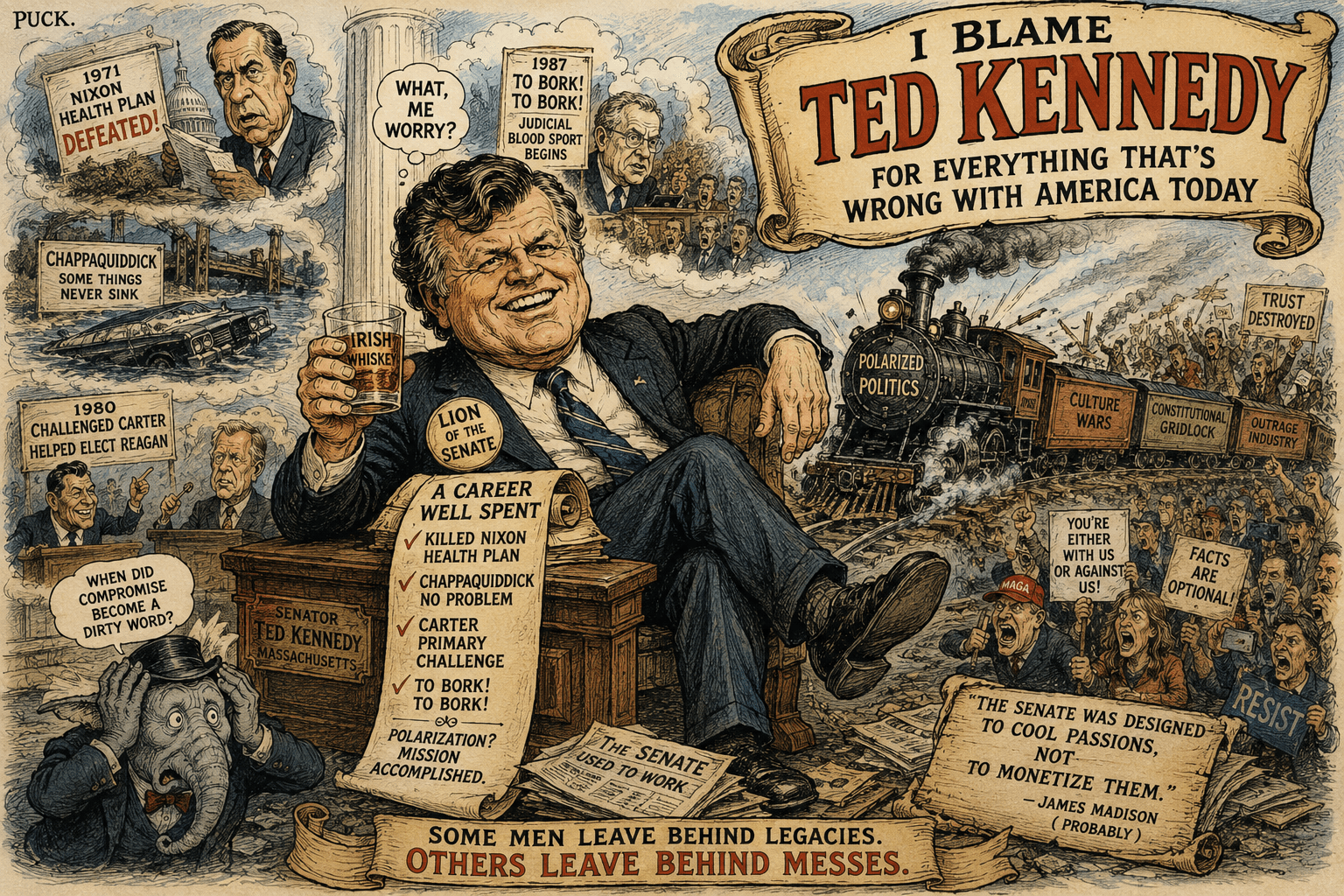
I blame Senator Ted Kennedy.
Not entirely, of course. James Madison would probably object to reducing the decline of a constitutional republic into a single-variable equation. Yet an astonishing number of modern American political dysfunctions seem to contain Ted Kennedy somewhere nearby holding a Senate speech, a moral lecture, or a tumbler of Irish whiskey.
History occasionally produces such men.
Now, before progressives begin clutching pearls and conservatives begin printing commemorative bumper stickers, some honesty remains necessary. Ted Kennedy possessed genuine political talent. The man understood legislation. The man understood institutions. Republican senators frequently liked him personally even while opposing him philosophically. Conservatives such as Orrin Hatch maintained a real friendship with him despite profound ideological disagreements.
Modern Washington barely allows members of opposing parties to share an Uber.
That contradiction makes Ted Kennedy fascinating.
Ted Kennedy may have represented both the last old-style Senate operator and the opening act for modern political tribalism.
Consider healthcare.
In the early 1970s, President Richard Nixon proposed a healthcare plan that, by modern standards, would probably send portions of conservative media into cardiac arrest. Nixon proposed employer mandates and expanded federal involvement in healthcare coverage.
Ted Kennedy helped kill the proposal.
Not because the proposal failed to expand government. Quite the opposite. Kennedy believed the proposal did not expand government enough.
That moment captures one of the great recurring pathologies of modern politics: the inability to accept partial victory because total victory appears emotionally preferable.
Then Ronald Reagan arrived and carried forty-nine states.
America has spent the next half century arguing about insurance forms while citizens glare at one another across social media trenches like exhausted soldiers trapped in bureaucratic Verdun.
Then came Chappaquiddick.
Watergate damaged trust in government. Chappaquiddick damaged trust in elite morality.
Americans historically tolerated flawed leaders. The republic survived Andrew Jackson duels, Lyndon Johnson arm-twisting, and Richard Nixon espionage fantasies. Yet Chappaquiddick introduced something uniquely corrosive: the perception that powerful families operated under separate rules entirely.
Average Americans noticed.
The old American civic faith depended upon equal justice under law. Chappaquiddick cracked part of that foundation and helped fuel the populist suspicion that elite institutions protected their own.
Modern anti-establishment politics did not emerge from nowhere.
Then came Jimmy Carter.
In 1980, Senator Kennedy launched a primary challenge against President Jimmy Carter during inflation, economic malaise, and the Iran hostage crisis.
Few men contributed more to Ronald Reagan’s victory than Ronald Reagan and Ted Kennedy.
Kennedy weakened Carter, fractured Democrats, and unintentionally accelerated the conservative revolution that reshaped American politics for a generation.
Conservatives should probably send the Kennedy family a fruit basket.
Then came Bork.
The battle over Robert Bork Supreme Court nomination transformed judicial confirmations from constitutional deliberation into ideological blood sport. Before Bork, nominees faced disagreement. After Bork, nominees faced organized political annihilation.
“To Bork” became an actual verb.
Modern confirmation hearings now resemble Roman coliseum spectacles sponsored by pharmaceutical companies and cable news panels. We can thank Uncle Teddy.
Ted Kennedy did not single-handedly create polarization. Universities radicalized portions of the Left. Cable news monetized outrage. Social media industrialized tribalism. Populists on the Right occasionally confuse volume with wisdom. Progressives occasionally confuse moral certainty with constitutional restraint.
Yet Ted Kennedy repeatedly appeared near moments where compromise collapsed and ideological maximalism triumphed.
Ironically, Kennedy himself often remained personally capable of compromise. The old Senate culture still lived inside him. He negotiated. He socialized. He built relationships across party lines. He understood that republics require political opponents to remain opponents rather than enemies.
Modern politics increasingly rewards performance over persuasion.
The old Senate operated through relationships, negotiation, private conversation, and institutional loyalty. The modern political ecosystem rewards outrage, ideological purity, performative morality, and viral clips designed for fundraising emails.
James Madison feared faction.
Modern America converted faction into a subscription business model.
The tragedy surrounding Ted Kennedy involves the possibility that he simultaneously understood the old system while helping destroy the norms that sustained the old system. We America counted on the Kennedy legacy most, Uncle Teddy did not deliver.
Some families leave behind railroads, universities, or industrial fortunes. The Kennedys may have left behind Edward Moore Kennedy.
Somewhere in the afterlife, James Madison still attempts to explain to Ted Kennedy that the Senate was never intended to function like Thanksgiving dinner with Irish whiskey, television cameras, opposition research teams, and twenty-four-hour media coverage.
Artificial Intelligence Disclaimer:
No senators, republics, or Irish whiskey were harmed in the drafting of this article. Portions of the satire were assisted by artificial intelligence trained upon centuries of human political dysfunction, congressional speeches, cable news outrage, and at least three emotionally unstable Reddit threads. The author alone remains responsible for the opinions expressed herein, although James Madison would probably demand a strongly worded footnote.