Forty-five years ago, Alvin and Heidi Toffler helped predict the Information Age. Would they recognize what is happening now?
A Book from the 1994 Republican Revolution
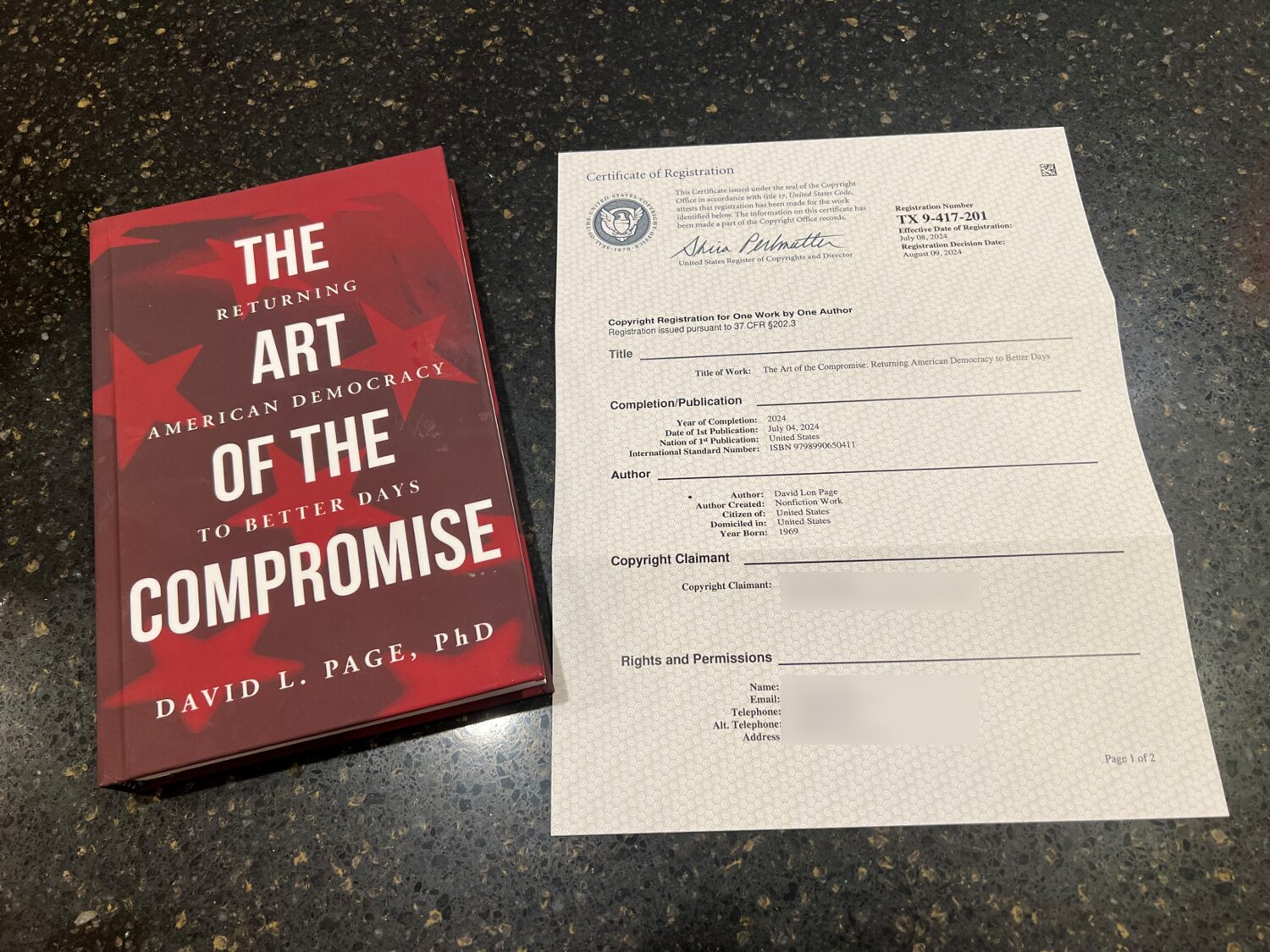
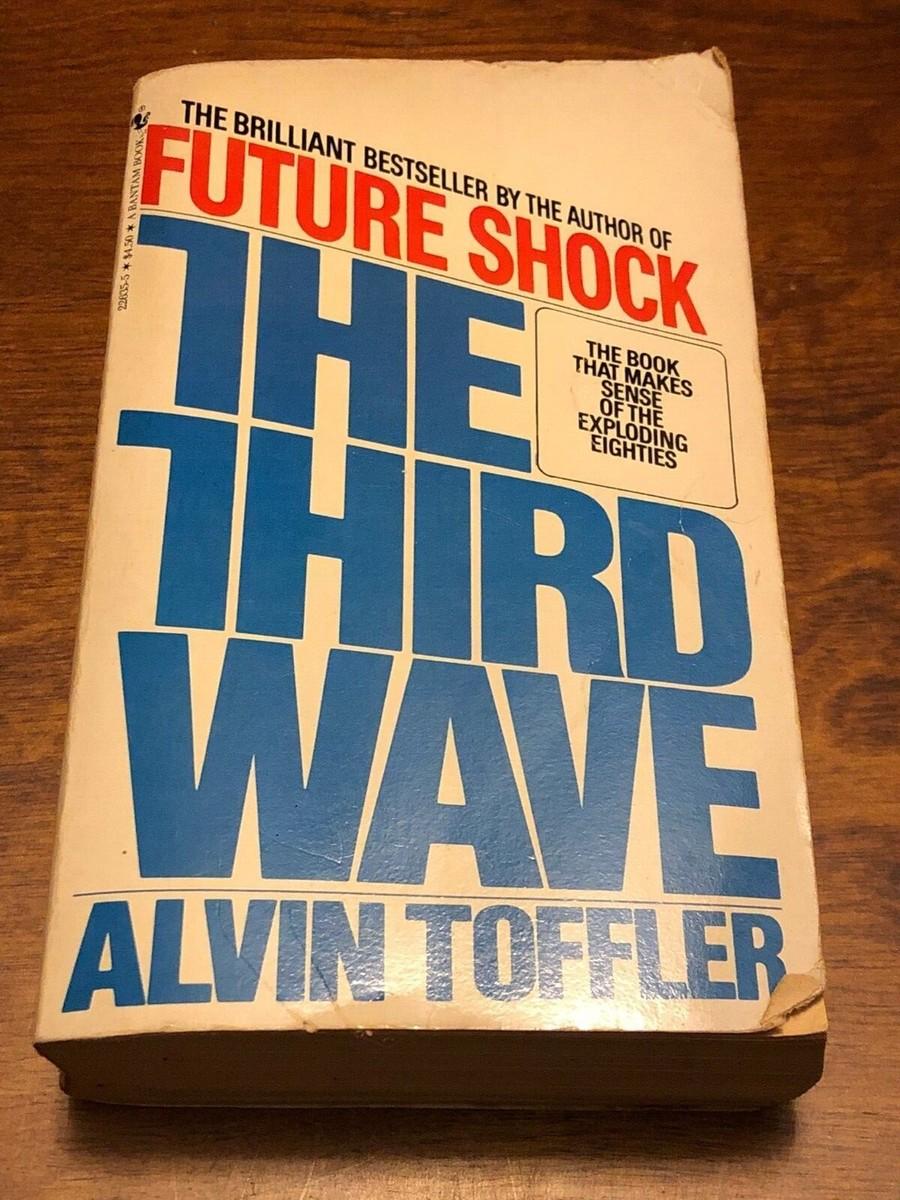
Each generation seems to have a handful of books that arrive at exactly the right moment. A young reader encounters an idea, and suddenly the world appears a little more understandable than it did the day before. Looking back across my own life, The Third Wave by Alvin and Heidi Toffler belongs firmly in that category.
I first encountered the Tofflers during the 1990s through Newt Gingrich. For younger readers, a bit of context may be helpful. Gingrich was not merely another Congressman. During the years surrounding the Republican Revolution of 1994, Gingrich occupied a role in conservative circles somewhat similar to the role Elon Musk occupies in technology circles today. Admirers viewed him as a visionary. Critics viewed him as a disruptive force. Nearly everyone agreed that he thought differently from most political leaders.

One characteristic especially caught my attention. Most politicians spent their time discussing legislation, elections, taxes, or government programs. Gingrich frequently talked about history. More precisely, he talked about where history was going. Interviews and speeches often wandered into discussions about technology, information networks, scientific change, and the future of American institutions. One book seemed to appear repeatedly in those conversations: The Third Wave.
At the time, I was an engineering student at Tennessee Tech trying to figure out what kind of future awaited beyond graduation. Personal computers were becoming commonplace, but the internet remained a novelty for many Americans. Google had not yet become a verb. Amazon was still largely an online bookstore. Few people carried cell phones, and nobody carried a smartphone. Choosing a career path in technology required a degree of faith because many of the industries that would eventually dominate the economy were only beginning to emerge.
Curiosity eventually led me to purchase a copy.
A young engineering student searching for clues about the future could hardly resist a book that had captured the imagination of one of the country’s most influential political leaders.
Alvin and Heidi
My first surprise came when I learned that The Third Wave was not merely the work of Alvin Toffler. Public attention often focused on Alvin, but the ideas emerged from a decades-long intellectual partnership between Alvin and Heidi Toffler. Later books properly carried both names as co-authors, reflecting a collaboration that lasted for much of their professional lives.
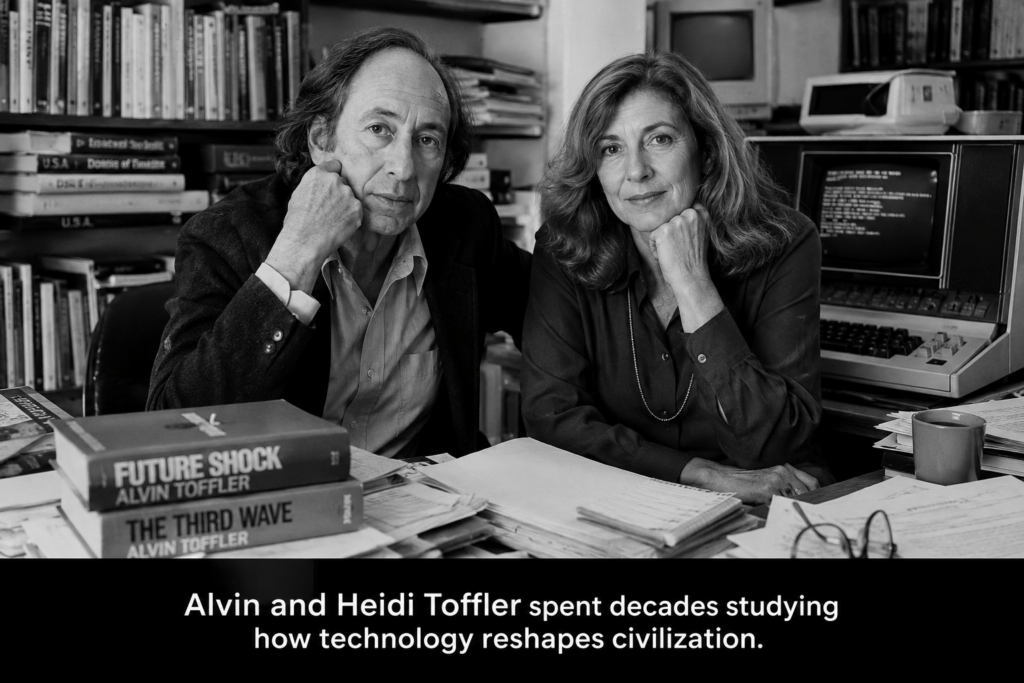
The Tofflers were futurists, though the term can sometimes create the wrong impression. Fortune tellers attempt to predict specific events. Futurists attempt to identify broad historical trends that shape societies over decades. The Tofflers were less interested in predicting which company might dominate a particular industry than in understanding how technological change alters the structure of civilization itself.
Political observers occasionally associate the Tofflers with Gingrich because he frequently cited their work. Such an association misses an important point. Alvin and Heidi Toffler were not Republican strategists. They were not Democratic strategists either. Their audience extended well beyond politics. Business leaders, educators, military officers, engineers, and policymakers all found value in their analysis because technological revolutions rarely confine themselves to partisan boundaries.
The Tofflers asked large questions. How do societies change? Why do institutions rise and fall? What happens when old assumptions collide with new technologies? Those questions fascinated me as a college student. Three decades later, those questions continue to fascinate me.
Three Waves
The central argument of The Third Wave was both elegant and ambitious.
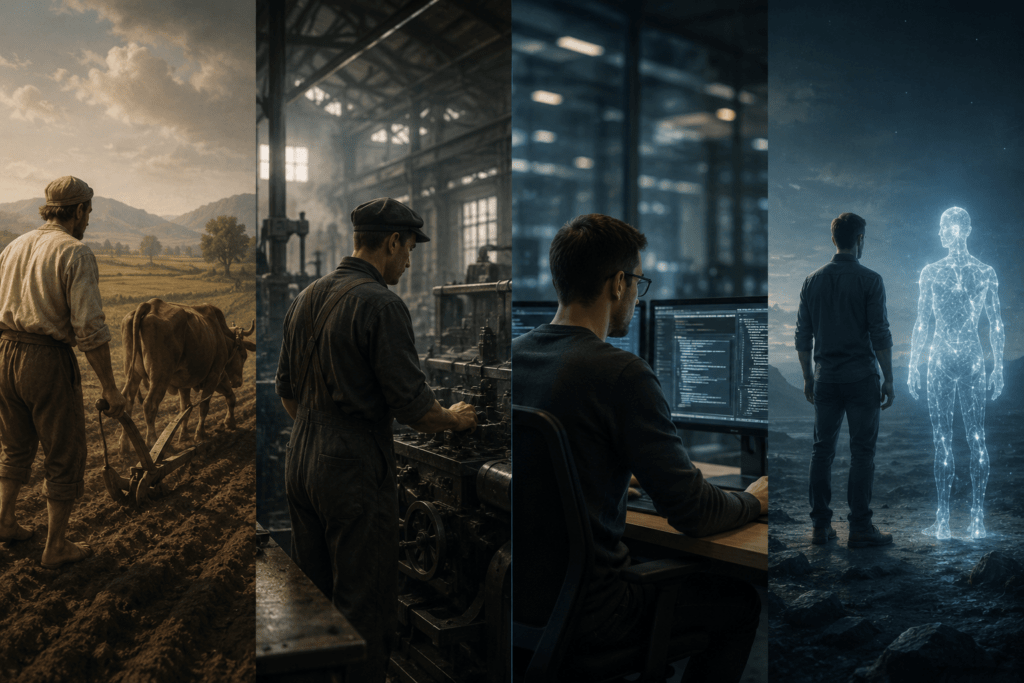
Human civilization, the Tofflers argued, had experienced a series of great transformations. The first transformation emerged with agriculture. Farming allowed human beings to settle permanently, accumulate surplus food, develop specialized labor, and eventually build cities. Agriculture did more than change how people worked. Agriculture changed how people lived.
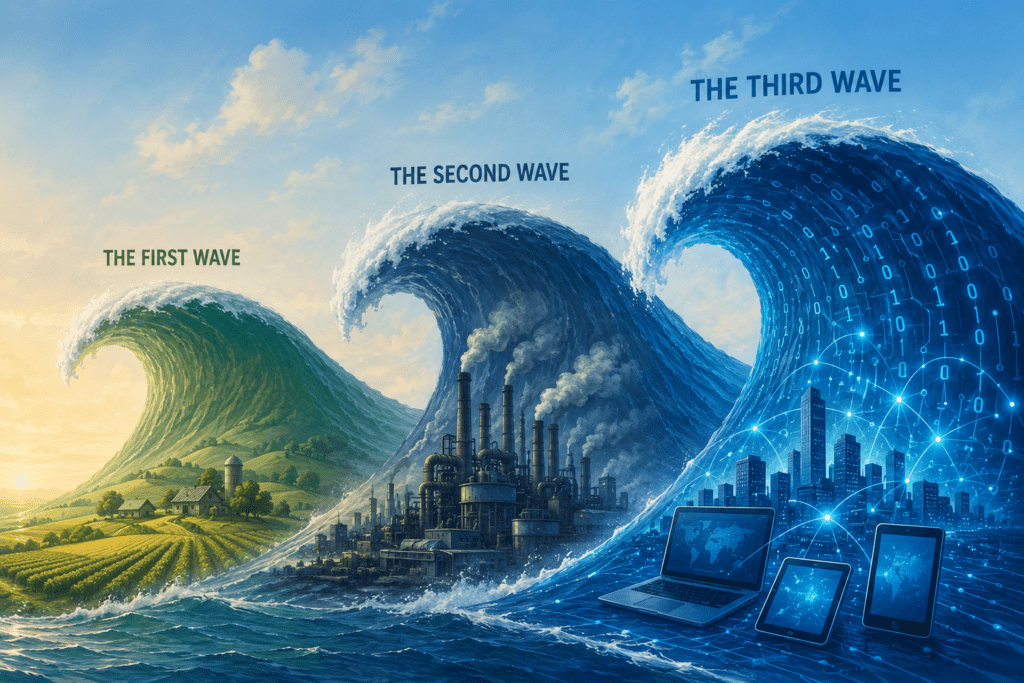
Thousands of years later, the Industrial Revolution unleashed a second great transformation. Factories replaced farms as the primary engines of economic production. Railroads connected distant regions. Mass production reshaped manufacturing. Large bureaucratic organizations emerged to manage increasingly complex societies. Schools, corporations, and governments gradually adopted structures designed for an industrial age.
The Tofflers believed a third transformation was already underway.
Computers, telecommunications, and information networks were creating a civilization organized around knowledge rather than industrial production. Information would become increasingly valuable. Knowledge workers would become increasingly important. Institutions built for an industrial age would struggle to adapt to a world where information moved rapidly, and traditional hierarchies lost some of their power.
Reading those ideas during the 1990s felt less like reading a prediction and more like reading a description of a world that was beginning to emerge around me. The internet was still young, but signs of change seemed to appear everywhere. A student could almost feel the current pulling society in a new direction.
The Tofflers did not tell me which career to pursue.
The Tofflers did something more useful.
They helped me recognize the direction of the current.
Looking Back
Forty-five years have passed since the publication of The Third Wave. Such a span of time provides a fair opportunity to evaluate a futurist’s work.
Many predictions proved remarkably accurate. Information became one of the world’s most valuable resources. Knowledge workers assumed increasingly important roles within the economy. Traditional media lost much of its gatekeeping authority. Work became less tied to physical locations. Information overload evolved from an academic concern into a daily reality for millions of people.
A reader can still open The Third Wave today and find observations that feel surprisingly modern.
No futurist predicts everything correctly, of course. The Tofflers did not foresee smartphones in their modern form. Social media culture would have been difficult for anyone to imagine in 1980. Few observers anticipated that billions of people would carry internet-connected devices in their pockets while voluntarily sharing photographs of lunch with strangers.
Even so, the broader framework aged remarkably well.
The Information Age arrived.
I spent much of my professional career living inside the world the Tofflers described.
Artificial Intelligence Feels Different
Lately, I have found myself wondering whether another Toffler-esque transition may be underway.
Looking back, most technological developments of the past thirty years fit comfortably within the framework of the Third Wave. Search engines helped people find information. Databases helped people store information. Websites helped people distribute information. Social media accelerated the flow of information. Each innovation expanded humanity’s ability to create, organize, transmit, and consume knowledge.
Artificial intelligence feels different.

A search engine retrieves information. A spreadsheet organizes information. A database stores information. Large language models participate in activities that increasingly resemble analysis, synthesis, and reasoning. A conversation with ChatGPT often feels less like searching a library catalog and more like collaborating with a research assistant.
Perhaps appearances are deceiving. Historians often draw cleaner distinctions than participants living through events. Citizens experiencing the early stages of the Industrial Revolution probably did not gather around dinner tables announcing the end of the Agricultural Age. Historical transitions rarely arrive with clear labels attached.
Yet artificial intelligence continues to nag at me because the technology appears to be changing something deeper than information access.
Agricultural technologies helped human beings produce more food. Industrial technologies helped human beings produce more physical goods. Information technologies helped human beings acquire and distribute knowledge more efficiently. Artificial intelligence appears capable of assisting with cognition itself. Whether machines truly think remains a philosophical question. Machines increasingly participate in activities that most people would have associated with thinking only a few years ago.
A society blessed with abundant intelligence may prove every bit as disruptive as a society blessed with abundant information.
What Would the Tofflers Ask?
Many contemporary discussions about artificial intelligence focus on capabilities. Can AI write code? Can AI pass exams? Can AI generate art? Can AI replace particular jobs?
Alvin and Heidi Toffler would likely have been interested in those questions.
I suspect they would have been even more interested in a larger set of questions.
The Tofflers rarely focused on technology for technology’s sake. Their real interest lay in understanding how technology reshapes institutions. A futurist examining artificial intelligence through a Toffler lens might spend less time evaluating benchmark scores and more time examining universities, corporations, governments, political parties, and professional organizations.
What happens to higher education when every student gains access to an inexpensive digital tutor?
What happens to journalism when research and analysis become increasingly automated?
What happens to professional expertise when sophisticated analytical tools become available to ordinary citizens?
What happens to representative government when information is abundant, and intelligence becomes dramatically less scarce?
Those questions strike me as profoundly Toffler-like.
James Madison designed constitutional structures for a world where information traveled at the speed of a horse. Alvin and Heidi Toffler helped readers understand a world where information traveled at the speed of light. Artificial intelligence raises the possibility of a world where analysis itself occurs almost instantaneously.
Many institutions may not be prepared for such a change.
A Fourth Wave?
I honestly do not know whether artificial intelligence represents the beginning of a Fourth Wave or merely the latest chapter of the Third.
Future historians will ultimately decide.

Yet I find myself returning to the same curiosity that led me to purchase The Third Wave as a college student. A young engineering student wanted to understand where the future might be heading. Three decades later, the question remains just as fascinating.
Agriculture transformed civilization.
Industry transformed civilization.
Information transformed civilization.
Artificial intelligence may eventually belong on that list.
Or perhaps future generations will conclude that AI was simply the most powerful expression of the Information Age.
Either way, I suspect Alvin and Heidi Toffler would have found the debate fascinating. More importantly, I suspect they would have encouraged us to look beyond the technology itself and focus on a larger question.
How will civilization change when intelligence becomes abundant?
Author’s Note: Artificial intelligence assisted with research, editing, and image generation for this article. The opinions, conclusions, mistakes, and speculation remain entirely my own. If Alvin and Heidi Toffler were right, perhaps collaborating with AI is simply part of living in the next wave.