★★★★½ — 4.5 out of 5 stars
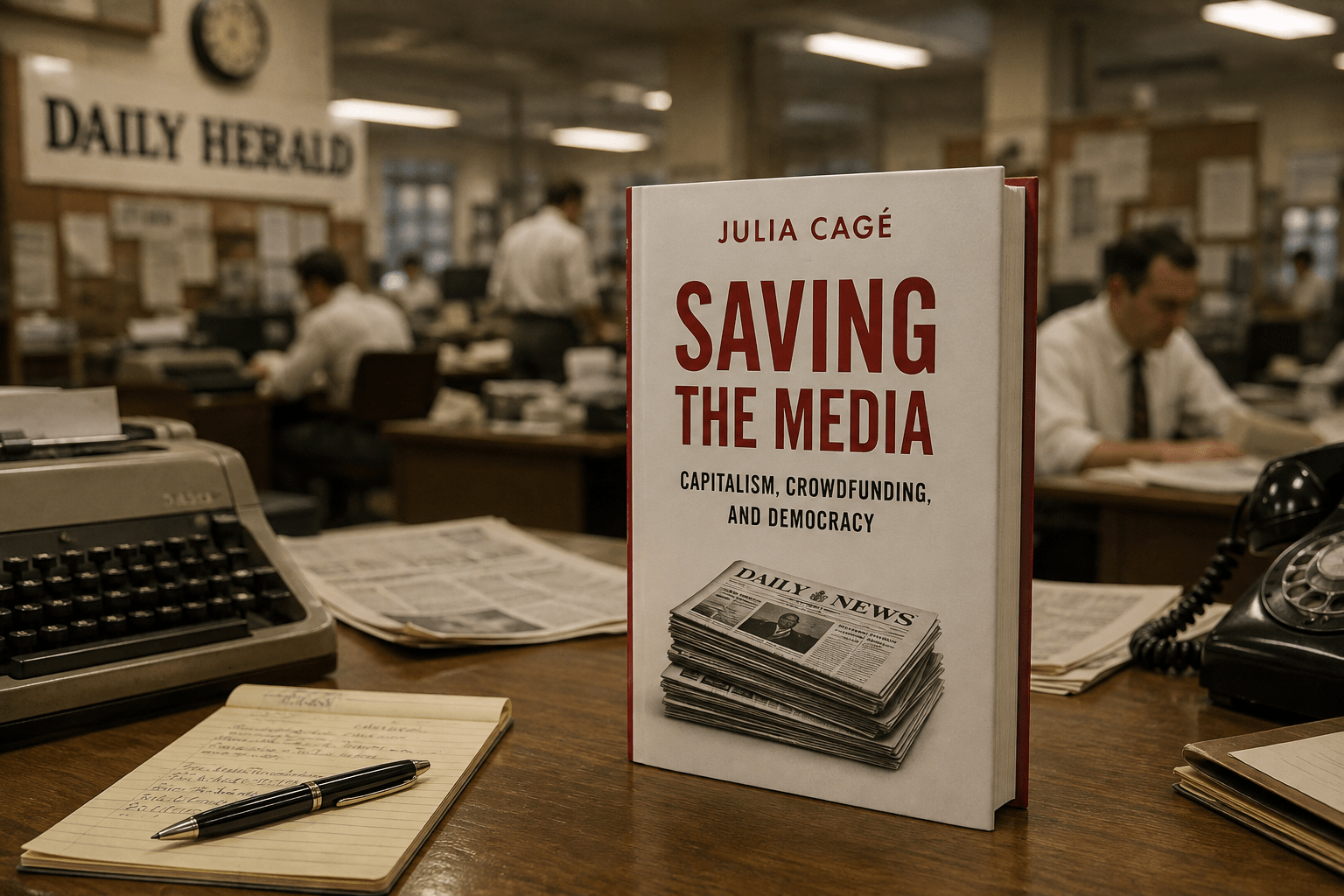
Julia Cagé’s Saving the Media: Capitalism, Crowdfunding, and Democracy is one of the most thoughtful books I have read about the crisis facing modern journalism. Cagé, an French economist, does more than lament declining newspapers, shrinking newsrooms, disappearing advertising revenue, and deteriorating news quality. She asks a harder question: What kind of institution is capable of producing quality journalism over the long term?
Her starting point is important. News is not merely another commercial product. Like education, university research, and other parts of the knowledge economy, quality journalism produces a public good essential to a functioning democracy. Yet we have largely expected journalism to survive under ordinary commercial rules. Cagé argues persuasively that the contradiction has become increasingly untenable.
Her most important contribution is therefore not simply her diagnosis. It is her proposed institutional remedy: the nonprofit media organization, or NMO.
The NMO sits somewhere between a charitable foundation and a conventional corporation. Cagé wants the permanence and public-purpose mission of a foundation without handing control to a few wealthy benefactors. At the same time, she wants some of the advantages of corporate ownership—capital formation, participation, and voting rights—without allowing whoever writes the largest check to control the newspaper. Her model therefore distributes power among readers, employees, crowdfunders, and larger investors while deliberately limiting the ability of any single wealthy investor to dominate the organization. Investments become permanent, voting rights accompany contributions, small contributors can combine their influence, and the voting power of very large investors is constrained.
That institutional architecture is, to me, the great contribution of the book.
In fact, I kept thinking about James Madison while reading it.
Madison did not design the Constitution on the assumption that public officials would always be wise, restrained, or virtuous. He designed institutions in which competing interests and powers checked one another. Cagé approaches journalism in much the same spirit. She does not ask us to trust the benevolent billionaire, the virtuous journalist, the generous philanthropist, the enlightened government official, or even the well-intentioned reader. Each has legitimate interests—and each can exercise too much power.
Her answer is structural: balance interest against interest and power against power.
That is a far stronger answer than simply pleading with media owners to behave better. Cagé is searching for a durable structure capable of producing good journalism even when the people operating within it are imperfect. Her NMO seeks a middle ground between what one account of her proposal aptly describes as “hypercapitalism” and “hypercooperation.”
Cagé does not pretend that she has produced the final answer. There are legal, tax, governance, and practical questions left unresolved. The book is better for acknowledging them. Her purpose is to put a serious structural alternative on the table and begin a conversation that journalism desperately needs.
I would pair Saving the Media with Andrey Mir’s Postjournalism and the Death of Newspapers. Mir is particularly useful for understanding how the collapse of the old advertising-supported newspaper model changes journalism’s incentives; Cagé asks what institutional structure might replace that dying model. Read together, the books provide an unusually powerful diagnosis of where journalism has been and where it might go.
I do see one important question that Cagé mostly leaves for others. She recognizes that how we consume news matters, noting the dramatically shorter time readers spend with online news compared with traditional print newspapers. Her principal concern, however, is understandably the economics and governance of producing journalism, rather than the design of its delivery.
Recently I spent several hours at my local library reading newspapers from the 1960s while researching local politics. I was struck by the experience of unfolding a full-sized newspaper. My eyes wandered. I scanned headlines. I discovered stories I had not been searching for. I lingered over articles because they happened to be sitting beside the article I originally wanted.
That experience is profoundly different from scrolling through a news site on a phone.
Digital news gives us extraordinary powers of search and instantaneous access, but perhaps we surrendered something important when we abandoned the physical newspaper: serendipity, context, sustained attention, and discovery. Cagé helps answer the question of how we might build institutions capable of producing quality journalism. A worthy extension of her work would ask the next question: How should we design the twenty-first-century newspaper so that people actually encounter, explore, and absorb that journalism?
Saving the Media does not have every answer. Cagé never claims that it does. But she asks the right question and, more importantly, thinks seriously about structure rather than good intentions.
That makes this a must-read for anyone concerned about the future of journalism—and ultimately the future of democratic self-government.
AI Note: I used AI to help research, fact-check, and polish this review. The ideas, judgments, and conclusions are my own.