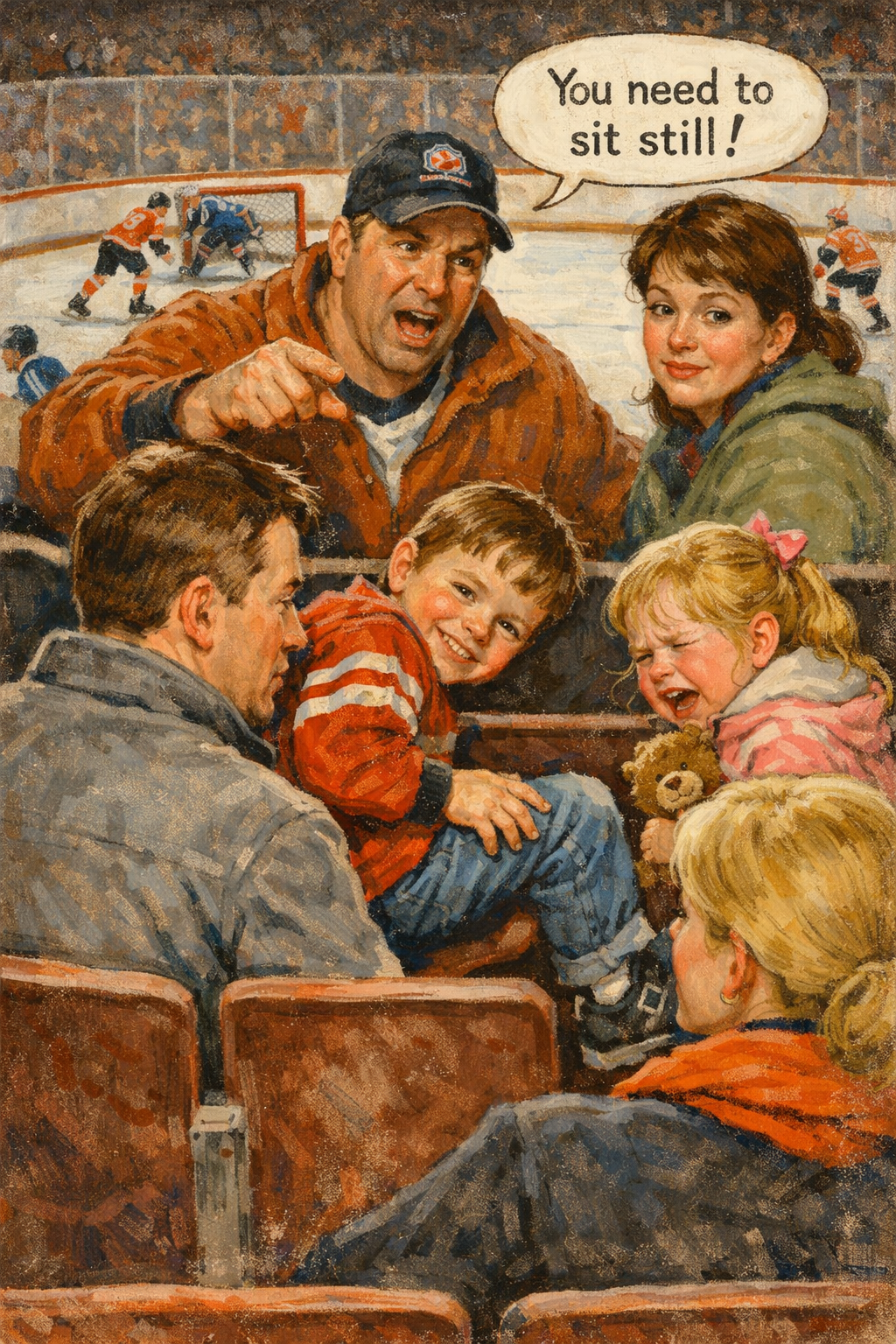
Lisa and I enjoy going to the Knoxville Ice Bears games. Hockey offers a pleasant mixture of athletic skill and controlled chaos. The puck moves faster than the eye can follow, the boards rattle, and the crowd roars with equal enthusiasm for goals and fights. The entire evening carries a healthy level of noise.
Noise, however, is different from disorder.
For several games now, the same family of four has occupied the row directly behind us. Two small children attend with their parents. The children appear energetic, which is a charitable way of saying that stillness is not a skill yet acquired. During a typical game, the children stand, twist, kneel on the seats, lean forward over the railing, and occasionally treat the backs of our chairs as percussion instruments.
The father attempts to manage the situation.
Attempt might be the correct word.
His parenting style consists primarily of loud announcements that appear directed as much toward the surrounding adults as toward the children themselves.
“Stop kicking the seat.”
“Hey! We do not behave like that.”
“You need to sit still right now.”
The statements arrive with impressive volume and theatrical seriousness. The effect resembles a public service announcement about proper behavior. Unfortunately, the announcements rarely produce the intended result. Within seconds, the small feet resume their rhythmic contact with the seatback.
Psychologists might call this performative discipline. The correction is real, but the primary audience is not the child. The audience is the room.
The parent signals to surrounding adults: Please understand that I disapprove of the behavior you are witnessing.
The child, meanwhile, hears a loud noise, pauses briefly, and then returns to exploring the laws of physics using the seat in front of them.
Lisa and I experienced a good example of this during the most recent game. The younger boy had discovered that kicking Lisa’s seat produced a satisfying vibration. The discovery led to repeated experimentation.
Thump.
Thump.
Thump.
The father delivered several firm vocal corrections from behind us. Each statement carried the tone of a courtroom verdict. Each statement had approximately the same behavioral effect as shouting at the wind.
Lisa and I exchanged the sort of quiet glance that long-married couples learn to interpret instantly. Rather than turning around and initiating a confrontation, we simply switched seats.
Problem solved, at least temporarily.
The rest of the evening unfolded in the familiar pattern. One child cried at several points. The father delivered additional announcements about proper conduct. The children continued behaving like children who had not yet mastered the concept of personal space.
None of this created a major disruption. Hockey games are noisy by design. The arena already contains flying pucks, smashing boards, and several thousand people cheering.
Still, the situation offers a useful observation about parenting and human behavior more broadly.
Children do not respond particularly well to performances.
Children respond better to relationships and roles.
When discipline becomes a public broadcast, the child often stops hearing the actual message. The correction becomes social theater rather than instruction. The parent attempts to repair reputation while the child continues exploring the environment.
The irony is that a quieter approach often works better.
Teachers and youth coaches use a small trick in situations like this. Instead of issuing a command, they recruit the child as a helper.
“Hey buddy, can you help me out? When the seat gets kicked, it moves a lot.”
That single sentence accomplishes several things. The child receives direct feedback from the person affected. The request assigns responsibility rather than shame. The parents avoid public embarrassment. Most importantly, the child understands the cause-and-effect relationship.
A surprising number of small disturbances disappear immediately once the affected adult becomes visible.
I should confess that I do not always handle such situations perfectly. My natural reaction leans toward quiet irritation rather than gentle diplomacy. Hockey games should involve pucks striking the boards, not small sneakers striking my spine.
Experience, however, continues to teach the same lesson.
Most public conflicts are not actually conflicts. They are simply misaligned feedback loops. The adult speaking loudly to the room has lost contact with the child who is actually generating the problem.
Sometimes the simplest solution is also the most direct.
Turn around.
Smile.
“Hey buddy, could you help me keep the seat steady?”
Children understand that message far better than a lecture delivered to the crowd.
And if that fails, the Ice Bears will almost certainly score soon enough to distract everyone involved.
Editorial note: ChatGPT assisted with editing. The observations about hockey games and performative parenting belong entirely to the author.