Every book grows from a shelf of older books.
No serious writer emerges from a vacuum. Every argument carries fingerprints from earlier thinkers, earlier historians, earlier observers who noticed some pattern in human nature before the rest of society finally stumbled into the same conclusion. My own book, The Art of the Compromise, rests upon dozens of such influences. James Madison looms over nearly every chapter. Alexis de Tocqueville wanders through the background like Banquo’s ghost. Lincoln, King, Meacham, Sartori, Lijphart, and Kamarck all helped shape the architecture.
Yet if a reader forced me to narrow the foundation to only three books, the answer would probably surprise many people.
Not Lincoln.
Not Hayek.
Not even The Federalist Papers.
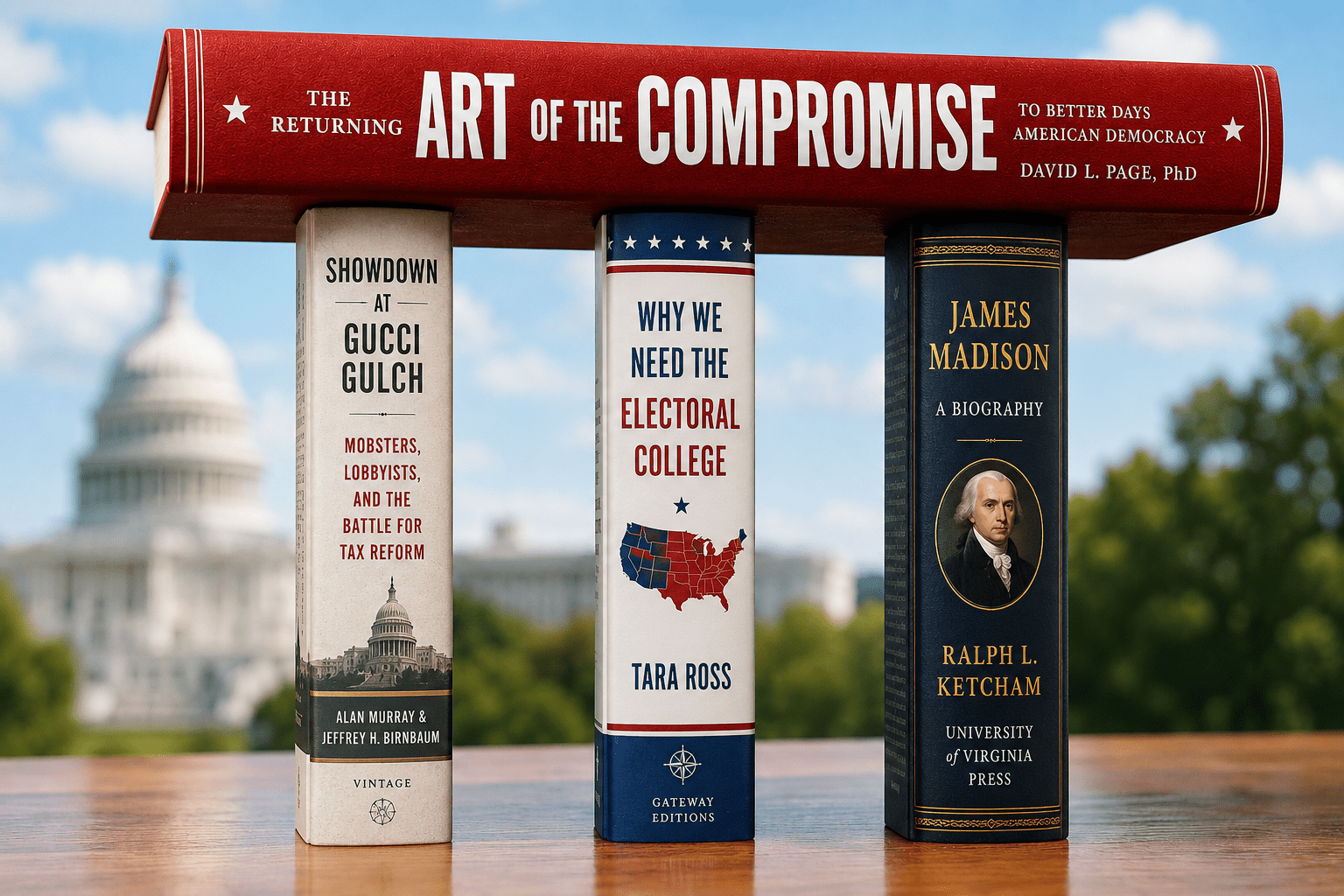
The three books beneath The Art of the Compromise are:
Strange company at first glance.
One book explores tax reform negotiations inside smoke-filled Washington rooms. Another defends one of the most hated institutions in modern American politics. The third studies a frail Virginian intellectual who rarely commanded attention when standing beside louder Founders like Jefferson or Hamilton.
Yet the three books share a common theme: civilization survives through structure, restraint, and compromise rather than emotional catharsis.
Modern America often celebrates passion. The Founders feared passion. Modern politics rewards spectacle. Madison feared spectacle. Cable television glorifies confrontation. Republics die from endless confrontation.
Those tensions sit at the center of my own work.
Gucci Gulch and the Lost Art of Political Adulthood
Showdown at Gucci Gulch may be the least famous important book in modern American political literature.
Most Americans have never heard of the 1986 Tax Reform Act. Most Americans probably should hear more about the event.
The story reads less like ideological warfare and more like trench engineering. Lobbyists, committee chairmen, policy experts, congressional operators, and White House negotiators spent months horse-trading through technical details most voters would consider painfully boring. Deductions disappeared. Rates shifted. Favors emerged. Deals collapsed. New deals formed by midnight.
Civilization moved forward anyway.
Washington during the 1980s still possessed enough institutional trust to allow serious bargaining behind closed doors without every compromise instantly becoming social-media heresy. No modern cable-news audience would tolerate the process. No modern activist ecosystem would survive the ambiguity.
A republic, however, cannot function without ambiguity.
Madison understood that reality. Congressional operators in Gucci Gulch practiced the same principle whether they recognized the connection or not. Durable government requires individuals capable of accepting partial victories without demanding total ideological surrender.
Modern Americans increasingly describe compromise as betrayal. Earlier generations often viewed compromise as adulthood.
That distinction matters.
The Electoral College and the Extended Republic
Few political institutions receive more ridicule today than the Electoral College. Yet Why We Need the Electoral College performs something increasingly rare in modern political writing: the book attempts to explain rather than merely inflame.
The Electoral College frustrates modern democratic instincts because the institution slows pure majoritarian emotion. The Founders intentionally designed such friction. Madison’s constitutional architecture never sought efficiency. Madison sought stability across a massive and diverse republic.
A pure national popular vote rewards emotional concentration. The constitutional system rewards distributed coalition-building across geography, culture, and competing regional interests.
Critics often interpret such friction as anti-democratic. Madison viewed such friction as the very mechanism that preserved democracy from self-destruction.
The distinction is not trivial.
France experienced repeated revolutionary convulsions during the nineteenth century partly because Paris could politically overwhelm the broader nation. America dispersed power across states, institutions, chambers, courts, and layered elections. The resulting system frustrates nearly everyone at different moments. The same frustration also slows political collapse.
The modern American citizen often desires immediate moral victory. Madison designed a system intended to deny immediate moral victory long enough for factions to cool.
No constitutional mechanism can permanently eliminate human tribalism. Madison merely sought to force tribal factions into negotiation before violence.
That insight became central to The Art of the Compromise.
Madison the Man
Many Americans speak reverently about James Madison without truly understanding the man himself. James Madison: A Biography helped change that for me.
Madison lacked Washington’s physical stature. Madison lacked Jefferson’s literary elegance. Madison lacked Hamilton’s theatrical intensity. Madison rarely dominated a room.
Madison listened.
Madison studied.
Madison worried.
Ketcham’s biography reveals a man deeply aware of humanity’s imperfections. Madison did not construct the Constitution because he believed Americans were angels. Madison constructed the Constitution because human beings were not angels.
That distinction separates constitutional government from utopian politics.
Modern political movements across the ideological spectrum often promise purification. Madison promised management. Modern activists seek permanent victory. Madison sought permanent equilibrium.
No constitutional order can produce heaven. A constitutional order can merely prevent hell from arriving too quickly.
Madison’s realism shaped nearly every page of The Art of the Compromise. My own book repeatedly returns to the same question Madison confronted after studying failed democracies across history:
How does a free society survive disagreement without eventually tearing itself apart?
The question remains unresolved.
Perhaps the question always remains unresolved.
The Shelf Behind the Shelf
Readers sometimes assume books emerge from solitary inspiration. Most books actually emerge from long conversations stretching across generations.
A reader who enjoys The Art of the Compromise will probably find value in all three books above. Each explores a different dimension of the same enduring American experiment:
How does a large, diverse republic continue functioning despite human ego, ambition, faction, greed, fear, and moral certainty?
Madison supplied the constitutional framework.
The Electoral College operationalized part of that framework.
Gucci Gulch demonstrated how imperfect human beings sometimes still manage to govern inside that framework.
None of the three books offer utopia.
All three offer something more useful: realism.
Modern America does not suffer from a shortage of passion. Modern America suffers from a shortage of institutional memory. Earlier generations understood that compromise was not weakness. Civilization itself often depends upon compromise.
The alternative usually arrives faster than societies expect.
For readers interested in exploring those ideas further, my own work continues the conversation in The Art of the Compromise and related books at Warped Minds Press.
Author’s Note on AI Usage:
No lobbyists were harmed in the drafting of this article, though several imaginary congressional staffers probably consumed alarming amounts of coffee during the writing process. Artificial intelligence assisted with editing and refinement, but James Madison still performed most of the heavy lifting from beyond the grave.