A reader recently asked me a fair question:
“What books most influenced More Republic, Less Cowbell?”
The answer surprised me because the list did not include grand philosophy, ancient political theory, or sweeping constitutional biographies. James Madison certainly hovers over every page of the book, but three modern works provided much of the practical framework beneath my argument.
Three books, written by authors from different disciplines and political instincts, all describe the same structural problem from different angles:
America slowly dismantled the institutional machinery designed to absorb political conflict before conflict reached the public square.
Congress weakened.
Parties weakened.
Newspapers weakened.
The republic grew louder as the institutions grew weaker.
My book largely explores the consequences.
Congress Forgot How to Be Congress
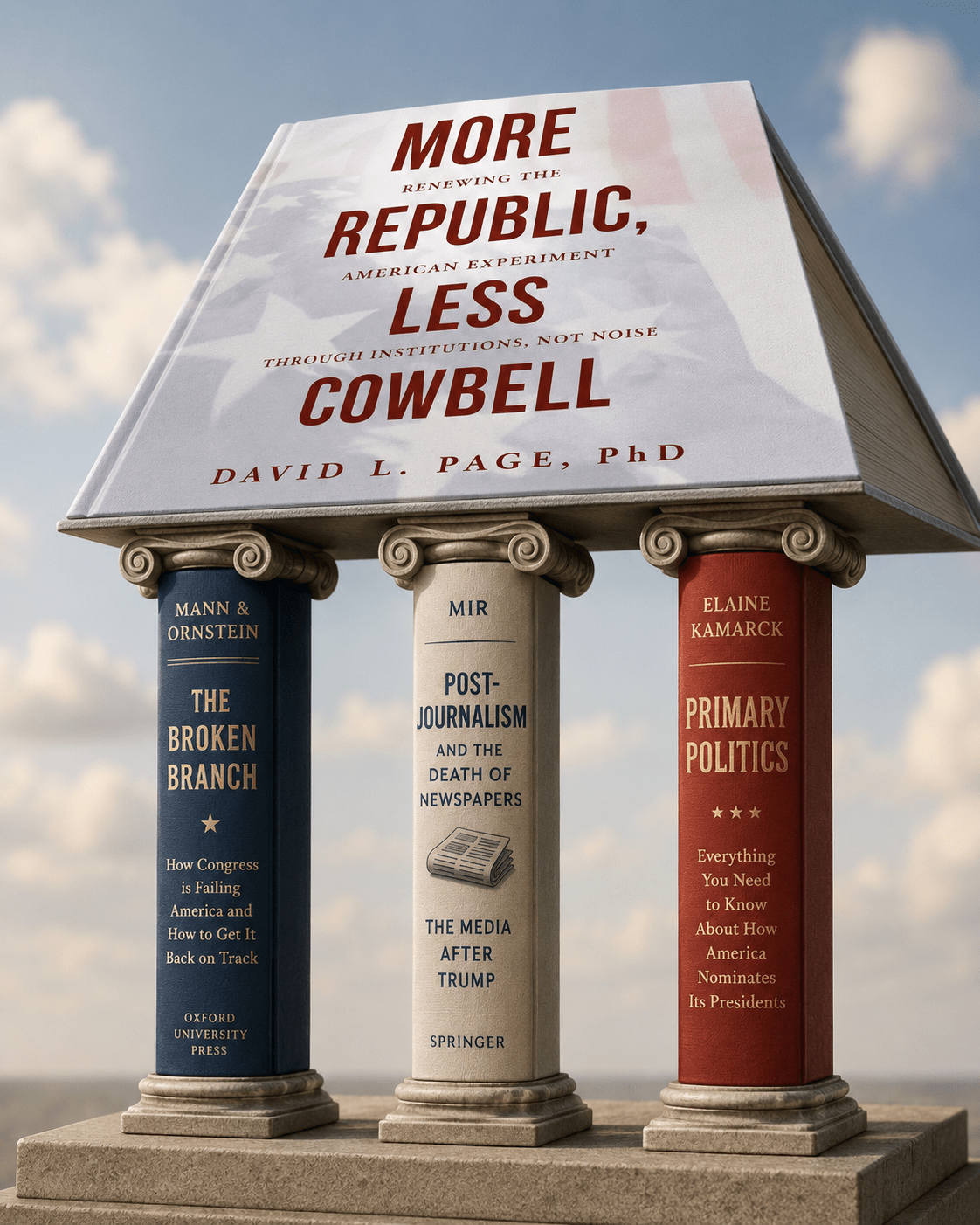
The first foundational book was The Broken Branch by Thomas Mann and Norman Ornstein.
Few modern books explain congressional decay more clearly.
Mann and Ornstein argue that Congress gradually abandoned regular order, committee power, bipartisan negotiation, and institutional loyalty in favor of permanent campaigning and performative politics. Members increasingly behaved like media personalities rather than legislators.
The title itself carries symbolic weight.
Congress represents the legislative branch—the branch closest to the people. When that branch weakens, public frustration does not disappear. Public frustration migrates elsewhere. Cable news absorbs part of the energy. Social media absorbs another portion. Populist personalities absorb the rest.
Nature abhors a vacuum. Republics do as well.
The Founders expected Congress to function as the central arena where factions collided, bargained, compromised, and ultimately cooled public passions before instability reached the broader republic. Mann and Ornstein document what happened after that cooling chamber stopped functioning properly.
Large portions of More Republic, Less Cowbell stand on that foundation.
Newspapers Died and Nobody Replaced Them
The second foundational book was Post-Journalism and the Death of Newspapers by Andrey Mir.
Mir’s argument struck me because the book explains modern political anger not merely as ideology, but as economics.
Traditional newspapers operated under scarcity.
Editors possessed limited space. Journalists faced publication constraints. Newspapers therefore filtered information aggressively because attention itself remained scarce and expensive.
Social media reversed the equation.
Information became effectively free while human attention became the scarce commodity. Modern media systems therefore optimize for emotional activation rather than civic stability. Anger travels faster than nuance because outrage monetizes attention more efficiently than restraint.
Mir describes the transition from journalism to “post-journalism” almost like an ecological collapse. Older media institutions once acted as gatekeepers and stabilizers. Digital systems instead reward immediacy, tribal signaling, conflict escalation, and emotional intensity.
The result appears everywhere.
Modern citizens often possess more information than previous generations while simultaneously possessing less shared reality.
That paradox sits near the center of More Republic, Less Cowbell.
Parties Stopped Filtering Candidates
The third foundational work was Primary Politics by Elaine Kamarck.
Kamarck examines the transformation of presidential primaries after the reforms following 1968. Much of modern political culture assumes democratization of the nomination process represented unquestioned progress. Kamarck presents a more complicated picture.
Older party systems certainly contained corruption, patronage, and insider manipulation. Few Americans wish to revive smoke-filled rooms entirely.
Yet older party systems also performed a filtering function.
Party elites vetted candidates. Governors, senators, donors, mayors, union leaders, and local organizers collectively evaluated temperament, coalition-building ability, governing competence, and ideological fit before candidates reached the national electorate.
Modern primaries weakened much of that filtering structure.
Candidates increasingly bypass party institutions and instead build direct emotional relationships with voters through media ecosystems optimized for outrage and virality. Political entrepreneurs now operate much like startup founders seeking market disruption rather than institutional stewardship.
The consequences appear obvious across both parties.
Celebrity politics rises.
Coalition-building weakens.
Performative conflict replaces negotiation.
Attention becomes more valuable than governance.
Kamarck’s work helped crystallize one of my core arguments:
A republic cannot survive solely on democratic energy. A stable republic also requires mediating institutions capable of channeling and cooling democratic energy.
The American system once possessed stronger institutional shock absorbers than modern Americans realize.
Many no longer exist.
The Common Thread
At first glance, those three books appear unrelated.
One focuses on Congress.
One focuses on media.
One focuses on party primaries.
Yet together, the books describe the same civilizational transition:
America shifted from a republic mediated through institutions toward a republic mediated through mass emotion—too much democracy, too much cowbell.
Congress weakened.
Parties weakened.
Local newspapers weakened.
Gatekeepers weakened.
Institutional loyalty weakened.
Meanwhile, mass communication accelerated toward instantaneous emotional reaction.
The result resembles a political system where the steering wheel disconnected from the tires while the engine simultaneously doubled horsepower.
That instability forms the central concern of More Republic, Less Cowbell.
The title intentionally sounds humorous because humor lowers defenses. Yet beneath the cowbell and political absurdity sits a serious argument:
A republic requires structure.
A republic requires friction.
A republic requires institutions capable of slowing public passions long enough for compromise to survive.
Modern America increasingly rewards speed instead.
That trade carries consequences.
Disclaimer: And because modern readers now demand disclosures before trusting anything they read: No AI system wrote More Republic, Less Cowbell. An AI system merely helped organize a blog post about books discussing the collapse of institutions that once prevented humans from outsourcing thinking to emotionally manipulative systems. History occasionally develops a sense of humor.