Is compulsory voting an answer, or just a warning sign?
A few years ago, I was talking with some Australian colleagues when the subject of voting came up.
They explained, rather matter-of-factly, that in Australia, voting is compulsory. Citizens are expected to show up. Elections are held on Saturdays. People often gather at polling places located at schools, churches, and community halls. And somewhere along the way, I heard about what I remembered as “freedom sausages.”
That phrase stuck with me.
As it turns out, I had the term slightly wrong. The Australian phrase is “democracy sausage.” At many polling places, local groups sell sausages as fundraisers while citizens come to vote. That may sound funny to American ears, but it also reveals something important. In Australia, voting is not treated merely as a private errand. It is treated as a public civic ritual.
That does not mean America should copy Australia. It certainly does not mean Knox County should rush into compulsory voting. In fact, I am not even sure Knox County could legally do such a thing through its charter form of government.
But I am interested in the question.
More precisely, I am interested in the problem that makes the question worth asking.
The Small-Faction Problem
In Knox County, local politics can be shaped by surprisingly small electorates. A county primary or county general election may determine who governs our schools, roads, taxes, sheriff’s office, courts, zoning fights, growth policy, and county budget. Yet turnout in these elections can be low enough that a motivated faction may exercise outsized influence.
That should make us pause.
James Madison warned that faction is not some temporary inconvenience that can be wished away. Faction is rooted in human nature. People have different interests, passions, loyalties, fears, ambitions, and resentments. The challenge of republican government is not to abolish faction. The challenge is to control its effects.
Madison’s great remedy in Federalist No. 10 was to “extend the sphere.” A larger republic would contain more interests, more opinions, more groups, and more cross-pressures. That variety would make it harder for one narrow faction to seize power in the name of the whole people.
But what happens when the political sphere shrinks, not because the county is small, but because very few people participate?
That is the Knox County question.
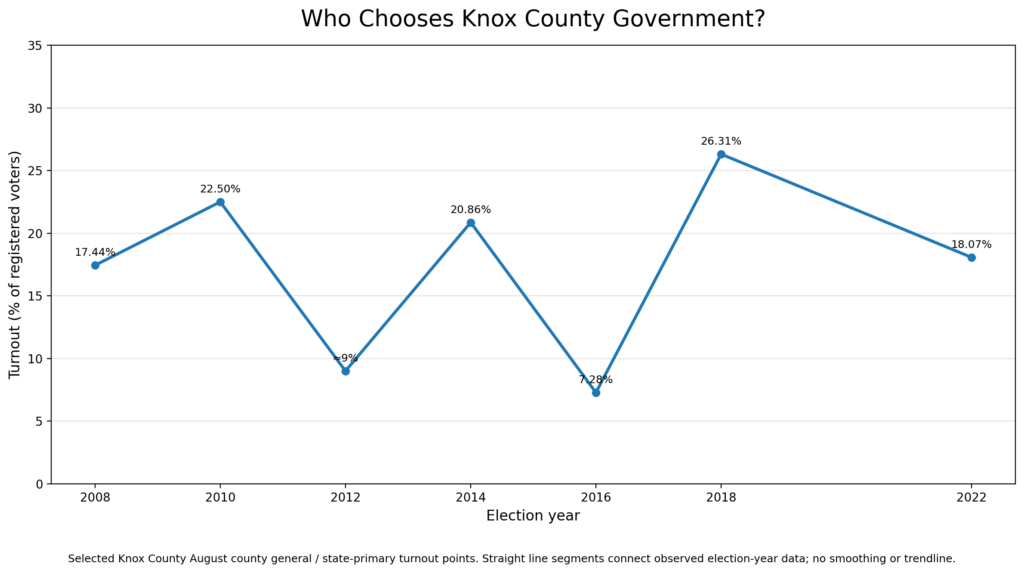
Caption: Selected Knox County August county general / state-primary turnout points. Straight line segments connect observed election-year data. The peak is just over 26% in 2018, with a low of nearly 7.2% in 2016.
The graph is not yet a complete century-long dataset. It is a starter chart, and I would want to verify every modern data point against the official Tennessee county turnout reports before treating it as final. But even as a preliminary illustration, the shape of the problem is hard to miss.
The offices closest to our daily lives are often decided in elections that draw a small fraction of registered voters.
The May 2026 Knox County primary provides another example. Knox County had 263,463 active registered voters at the time of the election. Only 56,006 cast ballots. That is a turnout of 21.25 percent.
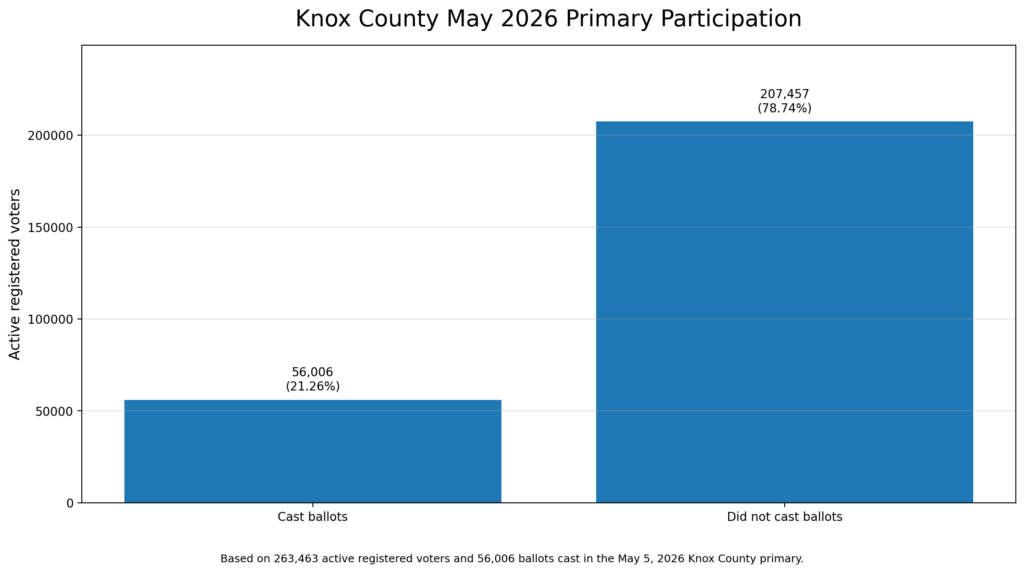
Caption: In the May 5, 2026, Knox County primary, 56,006 of 263,463 active registered voters cast ballots.
This turnout does not mean the voters who participate are wrong. It does not mean they are bad citizens. Quite the opposite. They are the ones showing up.
But it does mean that the governing voice of the county may be far narrower than the county itself.
When only one out of five active registered voters participates, the election may still be legal. It may still be legitimate under the rules. But a deeper republican question remains:
Are we selecting a broad governing coalition, or are we allowing the most motivated faction to speak in the name of everyone else?
What I Have Seen in Republican Club Meetings
This concern is not merely an abstract one for me.
I have attended Republican meetings in Knox County since my graduate school days in 1997. I have served for several years as president of the Karns Republican Club. More recently, I have been attending meetings of the West Knox Republican Club.
Over those years, I have noticed a pattern.
Inevitably, a new face will appear at a local Republican meeting. At first, I am encouraged. Maybe this person is someone who wants to participate in the party, help with events, knock on doors, study the issues, or become part of the long, unglamorous work of local self-government.
But nine times out of ten, those goals are not why the person has come.
They are thinking about running for office.
That reason is not a sin. Candidates should attend local party meetings. Anyone seeking office in Knox County should talk to Republican voters, Democratic voters, independents, neighborhood leaders, civic clubs, churches, business owners, teachers, parents, and ordinary citizens.
Still, the pattern is revealing.
Many people do not show up to local party politics because they want to participate in the party as an institution. They show up because they have realized that, in Knox County, winning often requires passing through the Republican primary or the Republican network. They may not have built the party. They may not have volunteered in the party. They may not have sat through the dull meetings, helped with the work, or participated in the debates.
But they understand the math.
Knox County is a Republican county. In many races, the Republican primary is the election that matters most. If turnout is low enough, a small but motivated group can organize, appear suddenly, “join the GOP,” and help decide who governs the county.
That reality is frustrating, but frustration is not the point.
The point is that low turnout creates opportunity. It creates a narrow gateway through which ambitious people, intense factions, or temporarily organized coalitions can pass. If fewer than one in four voters participate, and in some elections far fewer than that, then a candidate does not need to persuade Knox County. He or she only needs to persuade the portion of Knox County that actually shows up.
That reality is how a local republic shrinks.
Madison worried about small factions because they could coordinate more easily. In Knox County, the danger is not simply that the county is small. It is that the participating electorate can become small. When that happens, faction does not need to conquer the whole community. It only needs to conquer the room where decisions are actually made.
The Australian Provocation
This point in the story is where the Australian model becomes interesting.
Australia adopted compulsory voting in 1924 after turnout in a federal election had fallen below 60 percent. The change was immediate. Turnout rose dramatically at the next federal election and has remained high ever since. Australia’s system is not merely “show up if you feel like it.” The law treats voting as a civic duty.

Caption: Long before “democracy sausages” became part of Australian election day, Australia helped pioneer the modern secret ballot. The “Australian ballot” protected voters from intimidation by allowing citizens to vote privately, using government-issued ballots.
The American instinct recoils at that phrase: compulsory voting.
Mine does too.
I prefer the softer phrase “civic duty voting,” though even that may be too gentle for what the policy actually requires. A government mandate is still a mandate. A fine is still a fine—even if, in Australia’s federal system, the administrative penalty is only $20. A legal duty is still a legal duty.
So I find myself sitting as a juror, listening to both sides.
The Case for Civic Duty Voting
The case for civic duty voting is not foolish. It has real force.
The first argument is that it enlarges the electorate. If Madison wanted to extend the sphere to make faction less dangerous, then civic duty voting may extend the participating sphere inside a local election. It becomes harder for one organized faction to dominate when the entire county is expected to participate.
The second argument is that it changes the incentives of candidates. In a low-turnout election, the campaign question often becomes: Who can we mobilize? Who is angry enough to show up? Who is organized enough to deliver a bloc?
In a high-turnout election, the question shifts toward persuasion. Candidates must appeal not only to activists, insiders, and highly motivated voters, but also to the ordinary citizen who has a job, a mortgage, a family, and only limited patience for political drama.
That difference could be healthy.
The third argument is legitimacy. A county government chosen by a broad electorate is harder to dismiss as the product of a faction. Even people who lose can at least know that the winner had to face something closer to the whole public.
The fourth argument is civic culture. Voting can become more than a private act. It can become a community habit. Australia’s “democracy sausage” is funny, but it points to something serious. A free people must occasionally gather as a people. Voting can become a ritual of self-government rather than merely another chore.
The Conservative Objection
And yet the objections are serious.
The strongest conservative objection is simple: voting is a right, not a command.
A free citizen may have the right to vote, but that does not automatically mean the government should have the authority to compel him or her to vote. The right to speak includes the right not to speak. The right to worship includes the right not to worship. The right to assemble includes the right not to assemble. Perhaps the right to vote also includes the right to abstain.
Abstention is not always apathy. Sometimes it is protest. Sometimes it is conscience. Sometimes it is humility. A citizen may look at the ballot and honestly conclude that he does not know enough, trusts no candidate enough, or rejects the process itself.
A government that compels voting risks compelling expression.
Supporters of civic duty voting often respond that no one would be forced to support a candidate. A person could cast a blank ballot, spoil a ballot, or choose “none of the above.” The duty would be to participate, not to endorse.
That answer helps, but it does not erase the objection. Government would still be forcing a citizen into an expressive civic ritual. For many Americans, especially conservatives, that crosses an important line.
The Madisonian Objection
There is also a Madisonian objection.
Madison did not believe that more democracy automatically produces better government. He supported republican government precisely because raw public passion must be filtered, refined, checked, and structured. A low-turnout election may empower intense factions. But a compulsory high-turnout election may bring in voters who are uninformed, resentful at being forced, or easily swayed by shallow appeals.
Government can compel the hand to mark a ballot. It cannot compel the mind to deliberate.
Then there is the enforcement problem. What penalty would Knox County impose? A fine? A warning? A civil notice? A court process? A bureaucratic appeal system?
A reform intended to broaden democracy could easily become another way government punishes ordinary citizens. The people most likely to be fined may not be the powerful. They may be the poor, the elderly, the distracted, the working parent, the recently moved, or the person who never received the notice.
That possibility should trouble conservatives. It should trouble everyone.
Finally, there is the legal problem. Knox County likely does not have clear authority to impose compulsory voting through a county charter amendment. Election law is largely governed by the state. A county charter cannot simply override Tennessee election law or the constitutional rights of citizens.
So perhaps the better use of civic duty voting is not as an immediate proposal, but as a thought experiment.
If Not Civic Duty Voting, Then What?
What if Knox County put such an idea on the table, not because it is obviously legally viable, but because it forces us to confront a deeper problem?
If we reject civic duty voting, and perhaps we should, then what is our alternative?
Do we accept that local government will often be chosen by a small slice of the electorate?
Do we reform county primaries?
Do we require majority winners rather than plurality winners?
Do we consolidate election dates so local offices are not hidden in low-turnout cycles?
Do we mail every voter a plain-language voter guide?
Do we create more civic forums?
Do we strengthen local journalism?
Do we make voting easier without making it compulsory?
Do we ask candidates to build coalitions rather than merely mobilize factions?
These questions may be better answers. They may be more American answers. They may be more conservative answers.
But they are only answers if we are willing to admit the problem.
Madison warned that small factions are dangerous because they can more easily coordinate, act together, and impose their will. In a large republic, faction is controlled by expanding the number of people, interests, and opinions that must be accounted for.
Low-turnout local elections reverse that logic. They shrink the participating republic. They make the effective political community smaller than the actual community. They allow a few to act with the authority of the many.
That situation is the small-faction problem in Knox County.

Caption: Uncle Sam asks the question every republic eventually faces: who shows up to govern?
What Do You Think?
I do not know that civic duty voting is the solution.
As a juror, I am not ready to convict the current system, nor am I ready to acquit compulsory voting. The evidence cuts both ways.
Australia shows that civic duty voting can work. It can produce broad participation and a different civic culture.
America reminds us that liberty includes the freedom not to participate. A republic cannot preserve freedom by turning every virtue into a mandate.
So I am left with the question that may matter more than the proposal itself:
If we do not want compulsory voting, what are we willing to do instead?
Because doing nothing is also a choice.
And in a low-turnout system, doing nothing may mean allowing the most motivated faction to govern in the name of everyone else.
What do you think?
Is civic duty voting a bridge too far?
Or is it the kind of uncomfortable question Knox County needs to ask before small factions become the permanent engine of local government?
Disclosure: This essay was written with assistance from artificial intelligence, including help with research organization, drafting, editing, and chart preparation. The opinions, judgments, and final responsibility for the content are mine. The turnout data presented here should be understood as part of an ongoing effort to understand local participation in Knox County elections, and any preliminary figures should be verified against official election records before being treated as final.