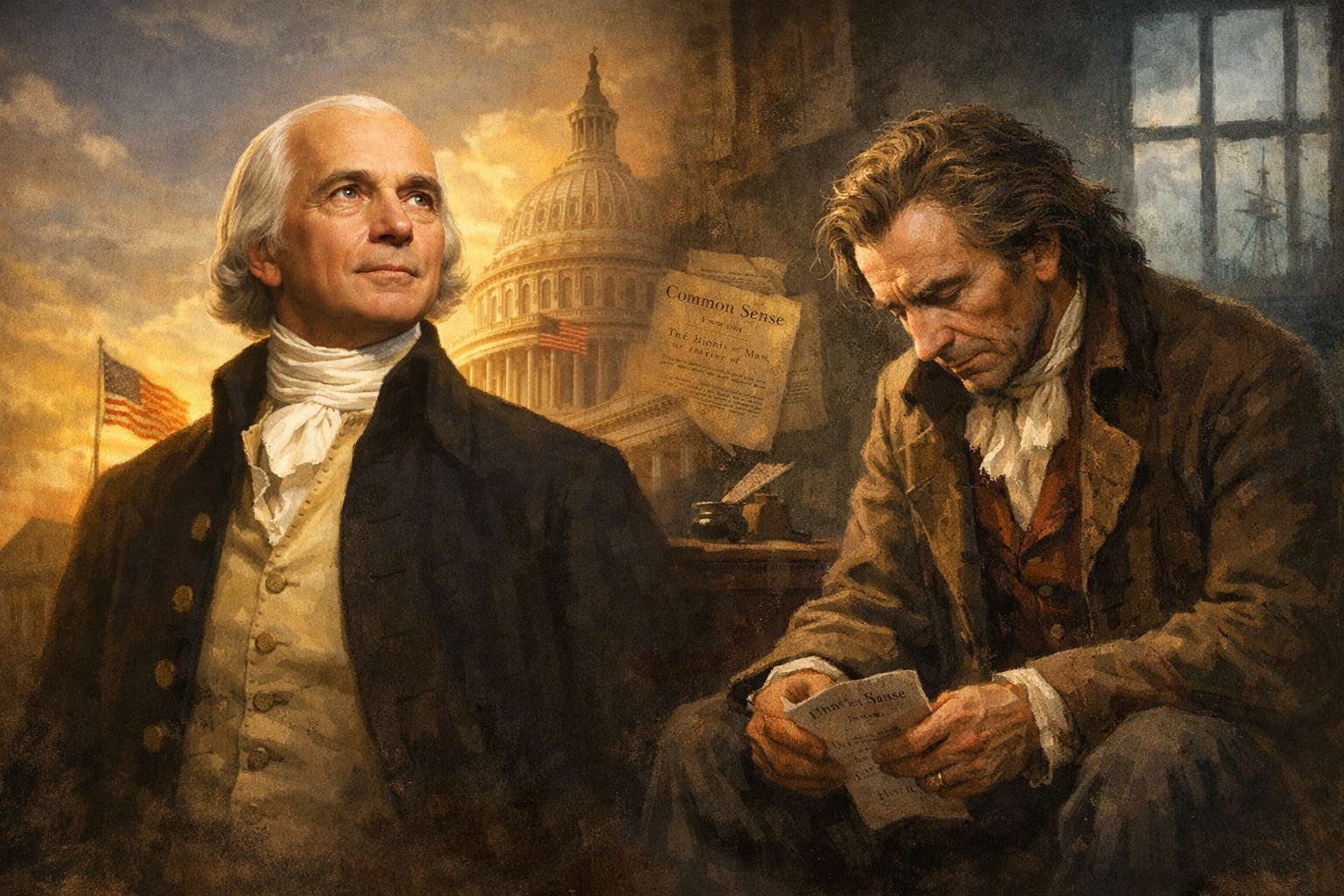
Thomas Paine and James Madison stood on the same revolutionary ground. Only one built something that lasted.
The American Revolution required firebrands before architects. Independence did not emerge from careful committee work. Independence required moral shock. Few figures delivered that shock more effectively than Thomas Paine. Common Sense stripped monarchy of its mystique and exposed inherited authority as irrational. Paine did not argue for reform. Paine argued for rupture. The pamphlet succeeded precisely because Paine refused moderation. Clarity came from extremity. Millions moved because the argument left no room for half measures.
That posture worked—until victory arrived.
Once independence ceased to be a proposition and became a condition, the political task changed. Governing required coalitions rather than converts. Governing required compromise rather than purification. Governing required restraint. Paine never made that turn.
Instead, Paine carried revolutionary logic forward without regard for context. Rights of Man pressed democratic equality to its logical edge. The Age of Reason extended the same uncompromising logic into religion itself. Each step followed clean reasoning. Each step narrowed Paine’s audience. Each step reduced Paine’s usefulness to those attempting to build and maintain institutions.
By the end of his life, Paine remained morally certain and politically isolated. England ignored him. America tolerated him without trusting him. Paine possessed influence without authority and conviction without coalition. Ideological purity had burned the bridge to power.
Now consider James Madison, whose temperament could not have differed more sharply. Madison never thrilled a crowd. Madison never spoke in absolutes. Madison did not seek moral unanimity. Madison assumed disagreement as a permanent condition of republican life.
Where Paine saw corruption in compromise, Madison saw danger in purity.
Madison’s genius lay in accepting human division and designing around it. In Federalist No. 10, Madison rejected the fantasy that liberty could be preserved by erasing factions. Factions were inevitable. Passions were ineradicable. The solution was not purification but containment—structures that forced interests to bargain before governing authority emerged.
Madison’s politics expanded the tent before decisions were made. Coalitions formed early. Extremes diluted. Outcomes moved slowly. Those features frustrated moral maximalists. Those features preserved legitimacy.
That difference explains why Madison governed and Paine did not.
The distinction matters now because modern party politics increasingly rewards Paine’s temperament while punishing Madison’s. Closed primaries, ideological litmus tests, and shrinking party tents mimic Paine’s logic. The aim is clarity. The cost is relevance.
When parties restrict participation to the most committed, those parties elevate intensity over breadth. Candidates win by pleasing the narrowest electorate rather than persuading the broadest coalition. Victory becomes more morally satisfying and less electorally durable. Governing becomes harder even when power is briefly secured.
Closed primaries function as purification devices. The mechanism rewards ideological sharpness rather than governing competence. The result resembles Paine’s trajectory after independence—argument without authority, conviction without control, righteousness without reach.
Open or semi-open primaries function differently. Those systems force early coalition-building. Candidates must speak across factions before power is conferred. Extremes face dilution. Compromise enters earlier. The process frustrates purists and strengthens governing capacity.
Madison understood that republican systems succeed not by amplifying passion but by filtering it. Parties originally served that filtering role. Coalitions formed inside the party before elections, not among the electorate afterward. Voters chose between governing teams rather than ideological sects. The system rewarded aggregation over activation.
Closing primaries reverses that design. Parties outsource coalition-building to the general electorate, where incentives favor conflict rather than settlement. The party becomes a megaphone rather than a mixer. The result resembles permanent revolution rather than durable rule.
Thomas Paine offers the warning. Moral clarity alone does not sustain political authority. Purity narrows. Narrowness isolates. Isolation ends relevance.
James Madison offers the alternative. Politics built on restraint, structure, and early compromise sacrifices rhetorical satisfaction for governing endurance. That trade-off preserved the American Republic through division far more severe than modern primary disputes.
Revolutions need Paine. Republics need Madison.
A party that treats ideological purity as virtue will eventually speak only to itself. A party that expands the tent before choosing leaders may frustrate its loudest voices, but that party preserves the capacity to govern.
History already tested both paths. Only one still governs.
Author’s Note: This piece was developed with the assistance of ChatGPT, used here as a research aide and argumentative sparring partner. ChatGPT provided structure, counterpoints, and historical recall. Final judgments, interpretations, and any stubborn opinions remain stubbornly human.