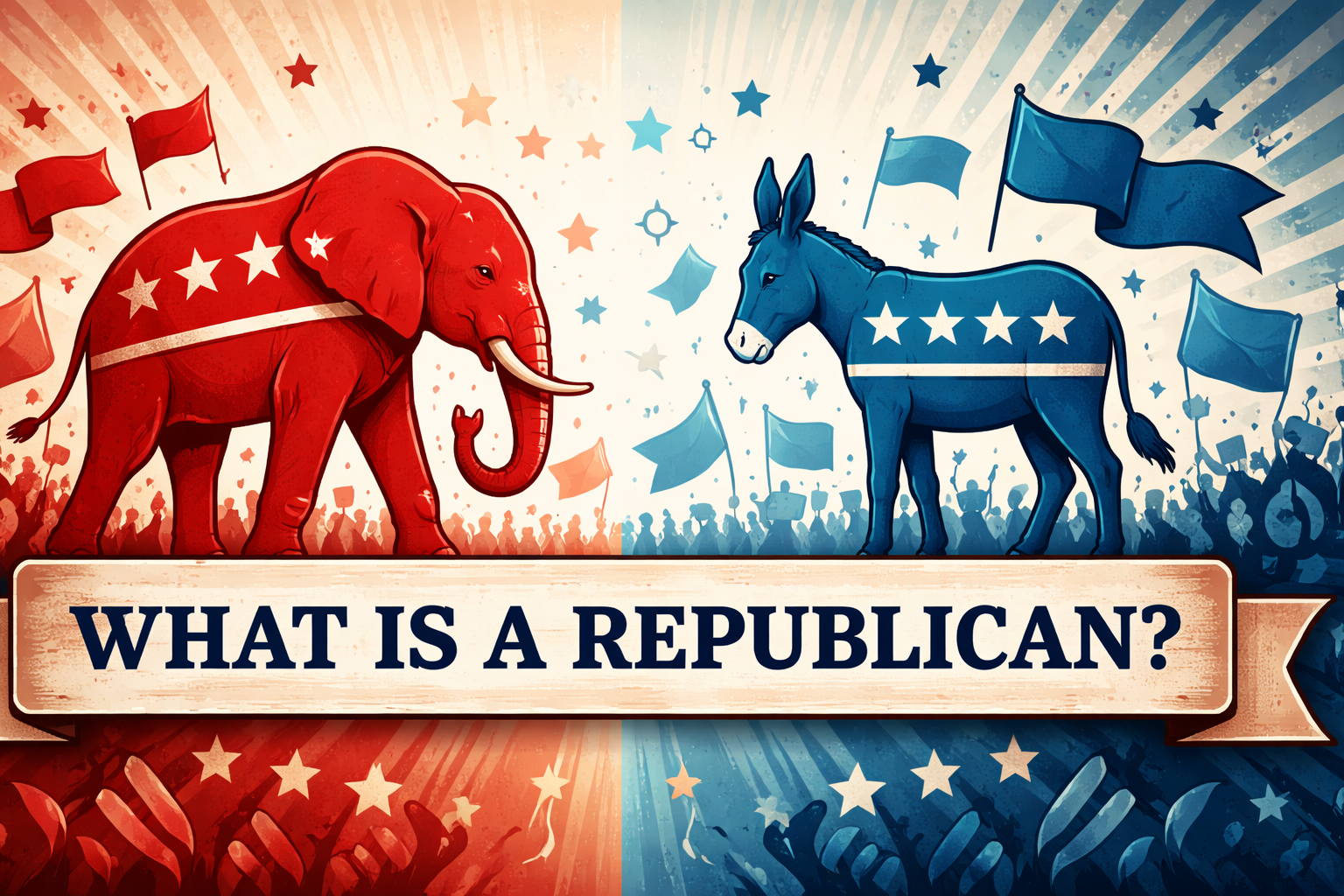
American democracy rests on a simple premise that once required no defense: political parties choose their own candidates.
Knox County now offers a test of that premise.
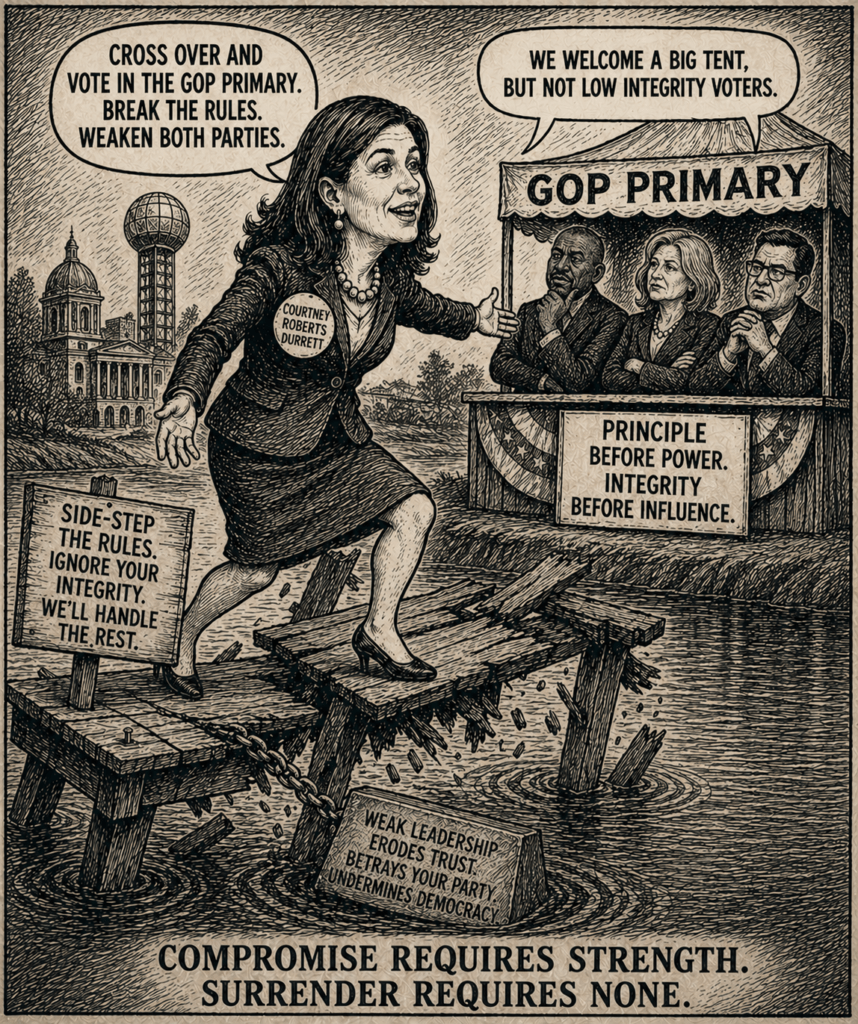
Courtney Roberts Durrett, an elected Democrat, has urged Democratic voters to cross over into Republican primaries. The argument carries a certain appeal. Knox County elections often favor Republican candidates, and the decisive contest frequently occurs before the general election ballot appears.
Practical reasoning alone cannot justify abandoning structural boundaries.
The Line in Law, However Imperfect
Tennessee law expects a voter in a party primary to qualify as a bona fide member of that party or to declare allegiance at the moment of voting. Enforcement remains rare. Definitions remain imprecise. The statute leaves space for interpretation.
Ambiguity does not erase obligation.
A private citizen standing in that gray area weighs conscience against strategy. A party leader who encourages mass movement across that line transforms ambiguity into organized conduct.
Leadership carries responsibility for the boundary, not permission to dissolve the boundary.
A Primary Serves a Purpose
A primary election does not exist as a public free-for-all. A primary election exists as a mechanism for a political party to select a standard-bearer.
Political science research, including Primary Elections and American Politics, reinforces a point often ignored in modern commentary. Party networks shape nominations. Activists, donors, and officials guide candidate selection long before voters cast ballots. A party functions as an institution with internal processes, not as a label available for public manipulation.
A party that cannot control its own nomination ceases to function as a party. Tennessee’s open primaries rely on the good-faith of voters and party leaders.

A Citizen’s Choice Versus a Leader’s Directive
A Knox County voter may conclude that participation in the dominant party’s primary offers the only meaningful voice in local governance. That conclusion reflects a political landscape shaped by long-standing partisan imbalance.
A Democratic officeholder urging organized crossover voting sends a different message.
Such a message concedes defeat within the Democratic Party. Such a message substitutes intervention for persuasion. Such a message invites Democrats to select Republican nominees rather than to build Democratic alternatives.
A citizen navigating a flawed system acts alone.
A leader directing coordinated action reshapes the system itself. Such low-integrity leaders, like Courtney Durrett, are antithetical to the good-faith necessary in the open primary system of Tennessee.
The Emotional Core: Boundaries Matter
A church may open doors to visitors. Visitors do not select the pastor.
A family may host neighbors at the dinner table. Neighbors do not determine inheritance.
A political party may operate within a public system. Outsiders should not choose the party’s nominee.
Durrett’s public call asks Democrats to step into a Republican process and influence a Republican outcome. That request does not expand democratic participation. That request erodes the meaning of party identity and continues to destroy the good-faith fabric of open democracies.
Durrett’s public call reflects either a failure to grasp the consequences or a willingness to set them aside. In her video, the presentation carries a tone of cleverness, as though a novel tactic has emerged to outmaneuver the GOP. The tactic is not novel. The tactic is corrosive. Such thinking, repeated across the political spectrum, fuels the frustration many voters now express.
The Cost of Strategic Cleverness
Short-term strategy often masquerades as long-term wisdom. Crossover voting may deliver a preferred candidate in a particular race. Such victories come at a structural price.
If both parties adopt the same tactic, primaries devolve into contests of interference. Candidates answer to no coherent base. Party labels lose clarity. Voters lose the ability to understand what a nomination represents.
A political system without clear party identity does not produce moderation. A political system without clear party identity produces confusion. While Durrett may view the tactic as clever, the pattern follows a familiar lineage—less innovation than echo—reminiscent of the monkey in The Monkey and the Cat, where cunning secures the reward and leaves others to bear the cost.
Aesop offered a warning long before modern elections. A monkey once persuaded a cat to pull chestnuts from a fire. The monkey enjoyed the reward. The cat carried the burns. Political cleverness often follows the same path. A tactic designed to outmaneuver an opponent rarely strengthens the system. A tactic designed to outmaneuver an opponent usually leaves lasting damage in its wake.

A Higher Standard for Leadership
Knox County presents a difficult environment for Democratic candidates. Difficulty does not excuse surrender.
Effective political leadership builds arguments, recruits candidates, and persuades voters. Effective political leadership does not redirect supporters into an opposing party’s internal decision-making process.
Durrett’s public stance reflects a choice. That choice favors expedience over integrity. That choice weakens the institution that grants the officeholder political identity in the first place.
Durrett presents the move as clever. The consequences tell a different story. Actions that blur party boundaries weaken public confidence and deepen the spiral of distrust in local government.
Closing
American democracy survives disagreement. American democracy depends on structure.
A party that relinquishes control of its own nomination relinquishes its voice.
A leader who encourages that surrender does not strengthen democracy.
A leader who encourages that surrender abandons the field.
Compromise requires strength. Surrender requires none.
AI Disclaimer: This essay includes assistance from artificial intelligence. The structure may reflect the machine. The convictions do not.