First Blood
The opening scene of First Blood does not begin with a war. The opening scene begins with restraint. John Rambo wanders into a small American town looking for food and perhaps a moment of rest. The sheriff decides that the town does not want trouble and drives the drifter back out. The story moves forward only because the sheriff escalates. Harassment turns into arrest. Arrest turns into abuse. Abuse triggers the response. Rambo does not start the conflict. Rambo responds to the conflict.
That narrative structure explains why the film resonated so deeply with American audiences. The appeal does not rest in violence. The appeal rests in moral sequencing. Someone else draws first blood. Only then does overwhelming force appear justified.
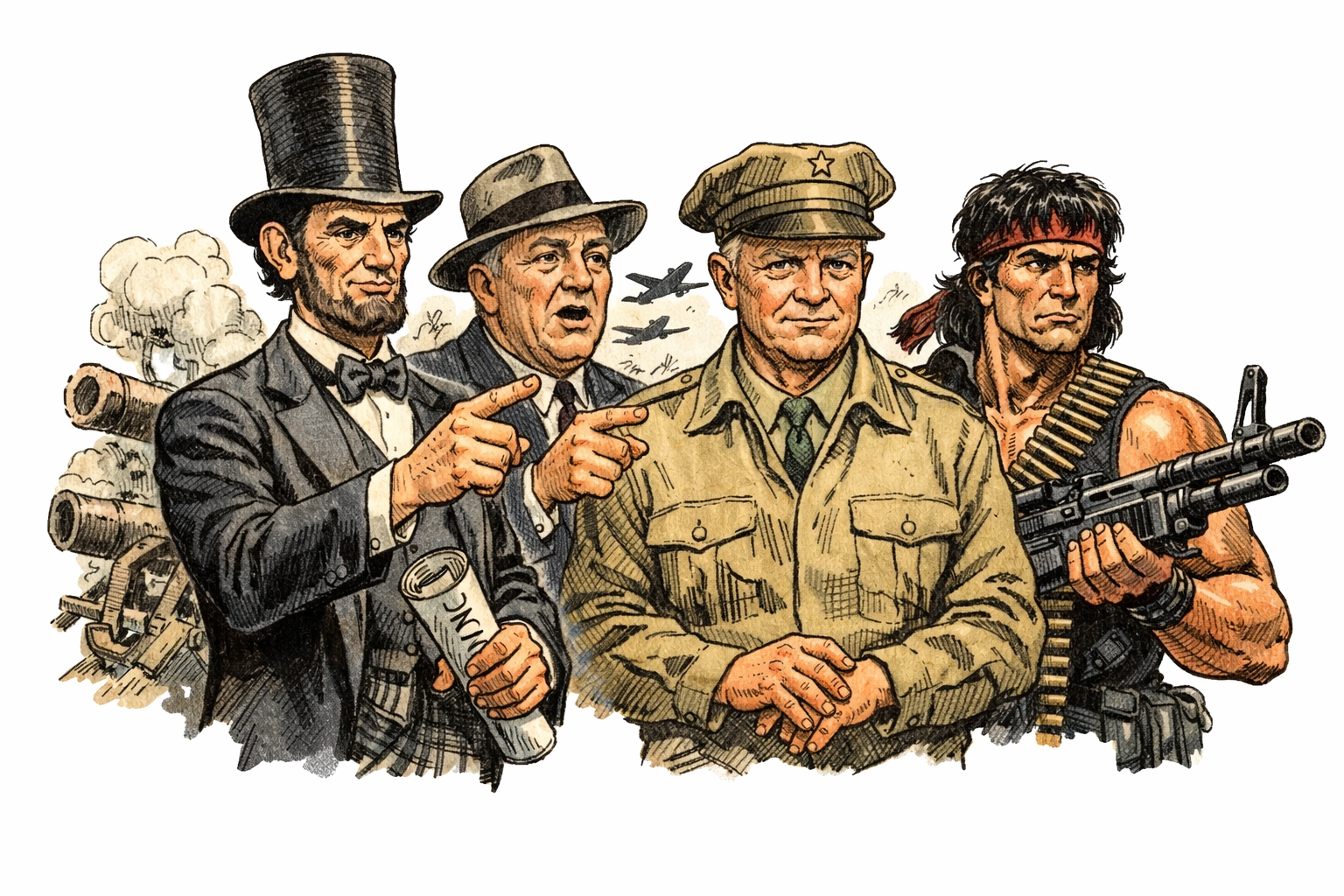
American foreign policy, across two centuries, often follows the same narrative arc. The United States tends to resist initiating large wars, yet once the nation believes that aggression has occurred, restraint often gives way to decisive and sometimes devastating mobilization. That pattern may be called, half-playfully yet analytically, the Rambo Doctrine. The immature version says: do not start the fight, but finish it brutally. The mature version, viewed through the strategic caution of Dwight Eisenhower, adds a prior step: prevent the fight whenever possible, because modern wars cannot be cleanly controlled once unleashed.
The tension between those two versions — cinematic retaliation and institutional restraint — runs through American history.
Roosevelt and the Edge of Pearl Harbor
Franklin Roosevelt spent most of 1941 navigating a political environment that resisted entry into global war. Public opinion leaned isolationist. Congress remained cautious. Roosevelt increased aid to Britain, strengthened naval patrols, and framed the United States as the “arsenal of democracy,” yet avoided initiating open hostilities.
On the evening of December 6, 1941, according to recollections of discussions with Harry Hopkins, Roosevelt rejected the idea of striking Japan first, replying that the United States was “a democracy and a peaceful people” and could not make the first overt move.
Within hours, Japan removed that constraint.
Roosevelt’s speech to Congress the next day framed the event not merely as an attack but as a moral transformation of national posture:
“Yesterday, December 7, 1941 — a date which will live in infamy — the United States of America was suddenly and deliberately attacked…”
The speech did not dwell on strategy. The speech established legitimacy. Roosevelt emphasized that the United States had remained in conversation with Japan seeking peace even as the attack unfolded.
Once legitimacy was secured, restraint disappeared. Industrial mobilization surged. Strategic bombing expanded. The war aim shifted toward what Roosevelt called “absolute victory.”
Pearl Harbor functions as the national version of First Blood’s inciting moment. The attack resolved political hesitation. The republic unified. The war machine moved.
Lincoln and the Guns at Fort Sumter
Abraham Lincoln confronted an even more delicate legitimacy crisis in 1861. Southern states had declared secession. Federal authority remained contested. Any aggressive move by Washington risked framing the Union as the instigator of war.
Lincoln’s First Inaugural Address therefore walked a narrow line. The Union would hold federal property and enforce national law, yet violence would occur only if national authority were attacked. The administration then notified South Carolina that Fort Sumter would be resupplied with food, not reinforced with troops.
The strategic trap was deliberate.
If the Confederacy allowed resupply, federal authority survived.
If the Confederacy fired, the Union gained moral clarity.
On April 12, Confederate artillery opened fire.
Lincoln’s call for volunteers followed immediately. Northern opinion hardened overnight. Congressional support surged. The war transformed from constitutional dispute into armed rebellion against national authority.
Lincoln’s later approval of Sherman’s destructive campaigns often appears harsh when viewed in isolation. Viewed through the legitimacy sequence, the escalation followed a defined logic. Once rebellion crossed into armed attack, the Union would use whatever military means proved necessary to restore national sovereignty.
Fort Sumter provided the republic’s “first blood” moment. Sherman represented the republic’s decisive response.
Eisenhower and the Mature Doctrine
Dwight Eisenhower stands apart because Eisenhower understood both sides of the sequence. The Supreme Allied Commander had witnessed industrial war at full scale. Cities burned. Millions died. Victory required overwhelming force, yet victory also revealed the terrifying cost of modern mobilization.
As president, Eisenhower rarely rushed toward military intervention. Korea ended early in his administration. Requests for major intervention in Vietnam were resisted. Middle Eastern crises were managed with pressure, alliances, and diplomacy rather than immediate invasion.
The famous farewell warning about the military-industrial complex reflected not abstract political theory but lived operational experience. Permanent war readiness, Eisenhower believed, risked distorting democratic judgment and pushing the republic toward unnecessary conflicts.
Through Eisenhower’s lens, the Rambo Doctrine gains maturity.
A republic should avoid drawing the knife at all.
A republic should maintain overwhelming strength.
If war truly becomes unavoidable, a republic should end that war decisively and quickly.
The goal shifts from retaliation to prevention.
Vietnam and the Broken Sequence
Vietnam represents the collapse of the legitimacy-then-decisive pattern. John Kennedy expanded advisory involvement without formal declaration of war. Lyndon Johnson escalated gradually through the Gulf of Tonkin framework. Robert McNamara pursued calibrated pressure, hoping that measured bombing and troop increases would coerce negotiation without triggering wider conflict.
The war never produced a Fort Sumter moment. No single attack unified national will in the way Pearl Harbor had done. The enemy lacked a single decisive center whose defeat would end resistance. Incremental escalation replaced overwhelming mobilization.
Richard Nixon eventually recognized the structural trap. Vietnamization and negotiated withdrawal replaced hopes for decisive victory. The United States exited not through battlefield collapse, but through strategic disengagement.
The Rambo sequence never activated because the war lacked the clear initiating event and achievable termination condition that decisive doctrine requires.
Two Bushes, Two Gulf Wars, Two Doctrines
George H. W. Bush confronted Saddam Hussein’s invasion of Kuwait in 1990 — one of the clearest interstate aggressions of the late twentieth century. Congressional authorization followed. A multinational coalition assembled. Diplomatic deadlines expired. Only then did Operation Desert Storm begin.
Once hostilities opened, the campaign used overwhelming air power, rapid maneuver, and tightly defined objectives. Kuwait was liberated. The campaign ended. The sequence mirrored the classic legitimacy-then-decisive structure.
George W. Bush’s 2003 Iraq invasion began differently. The initial military campaign succeeded rapidly. Baghdad fell within weeks. Yet the strategic objective extended beyond territorial liberation toward regime transformation and political reconstruction.
The conflict mutated into insurgency. Victory no longer had a single definable endpoint. The long war that followed resembled Vietnam far more than Desert Storm.
One Gulf War matched the classic doctrine. The other demonstrated how easily decisive victory dissolves when war objectives shift from defeating armies to reshaping societies.
Trump, Iran, Venezuela, and the Unfinished Test
Recent debates over American policy toward Iran and Venezuela sit in a different historical category. Modern military technology allows targeted strikes, covert operations, sanctions, and leadership-focused pressure without full-scale invasion. The boundary between war and coercion has blurred.
Some actions appear closer to limited shock operations designed to compel political outcomes rather than to initiate sustained campaigns. Supporters interpret these actions as strategic deterrence. Critics interpret the same actions as destabilizing escalation.
History has not yet delivered a final verdict.
Unlike Fort Sumter or Pearl Harbor, modern confrontations often unfold in fragmented episodes rather than singular defining attacks. Unlike Vietnam, modern operations sometimes avoid prolonged occupation entirely. The emerging doctrine remains unsettled, and judgment may require decades rather than election cycles.
Readers may draw their own conclusions.
The Republic and the Knife
The enduring lesson across Lincoln, Roosevelt, Eisenhower, Vietnam, the Gulf Wars, and present tensions is neither cinematic nor ideological. The American republic functions best in war when three conditions align: visible aggression, congressional legitimacy, and a clearly achievable military end state.
Hollywood dramatizes the emotional moment when first blood is drawn. History shows that republics require something more complicated: not only the moment of attack, but the institutional foundation that allows force to end conflict rather than perpetuate it.
John Rambo fights alone in the woods.
Presidents do not have that luxury.
A republic must decide not only when to fight, but whether the structure of the conflict permits victory at all.
Author’s Note on AI Assistance
This essay was prepared with research and drafting assistance from artificial intelligence tools. Historical quotations, timelines, and structural comparisons were developed collaboratively, with the author reviewing sources, verifying context, and making final editorial judgments. Any remaining errors in interpretation, emphasis, or tone remain the responsibility of the human author, who continues to insist on retaining credit for both the good ideas and the questionable metaphors.
Artificial intelligence helped accelerate the assembly of facts. Judgment, conclusions, and stubborn opinions remain entirely human.