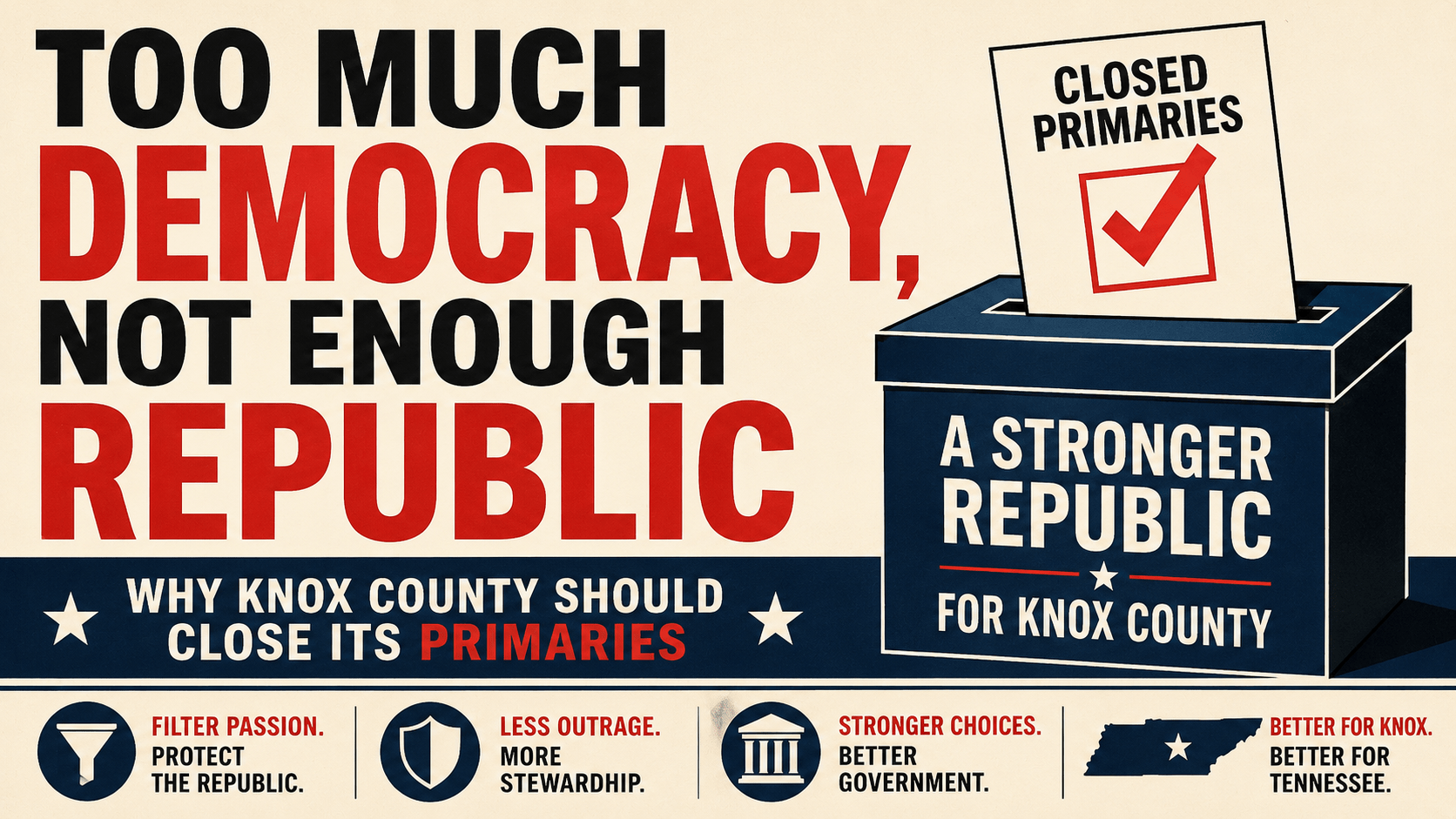
Too Much Democracy, Not Enough Republic
Closed primaries will not save Knox County politics. Closed primaries will not end polarization. Closed primaries will not magically produce wise statesmen from a broken political culture.
Closed primaries would, however, restore one small but important republican—little “r,” not party—principle that modern Knox County and America have steadily abandoned: political power should pass through filters before passion becomes governance.
For years, I defended open primaries as more democratic, more inclusive, and more fair. Recent Knox County elections forced me to reconsider that position. The change did not emerge from bitterness over a particular outcome or from outrage over crossover-voting controversies.
In fact, I voted in the Republican primary and supported several members of the conservative coalition slate that ultimately prevailed in Knox County, as noted recently by the Knoxville News Sentinel. My concern is not ideological victory or defeat. My concern is structural.
The recent election exposed something larger and more troubling. Modern party politics increasingly rewards temporary emotional activation rather than long-term coalition stewardship, as Elaine Kamarck documents.
Modern Americans often speak as though democracy and republicanism are interchangeable concepts. The Founders understood the difference clearly. James Madison, Alexander Hamilton, and many delegates at the Constitutional Convention distrusted pure democracy precisely because pure democracy concentrates public emotion too quickly into political power.
The Constitution, therefore, created a republic layered with institutional friction designed to slow public passions and refine public opinion before temporary outrage hardened into law.
Democracy provides the political energy. Republicanism provides the structure that filters and channels that energy.
The original Senate came from state legislatures rather than direct elections. The Electoral College inserted another filtering mechanism between public sentiment and executive power. Federalism dispersed authority geographically. The separation of powers fragmented authority institutionally. Even staggered elections served a purpose beyond administrative convenience. The constitutional system intentionally slowed democratic energy before converting that energy into state action.
Knox County government operates through a similar republican structure. County Commissioners share legislative authority while independently elected constitutional officers divide executive power with the mayor inside Tennessee’s weak-mayor system. The structure fragments power intentionally because concentrated power invites instability.
Madison described the purpose directly in The Federalist Papers when he argued that republican government should “refine and enlarge the public views.”
Modern primary systems increasingly accomplish the opposite.
America’s Two-Stage Democracy Problem
America now operates what amounts to a two-stage democratic filtration process. First comes the primary. Then comes the general election. Both stages reward different forms of political activation, but neither stage resembles the republican filtering mechanisms the Founders preferred. Both stages increasingly resemble the pure democratic immediacy the Founders feared.
Open primaries intensify the problem further.
A citizen may remain politically disengaged for years, become enraged over a single controversy, temporarily participate in a party primary, and help determine nominees who may govern Knox County for years afterward. Modern media ecosystems magnify that dynamic daily. Facebook, cable news, viral clips, and outrage algorithms reward emotional intensity rather than institutional patience. Anger mobilizes more reliably than satisfaction. Temporary outrage spreads faster than durable consensus.
One Knox County Commissioner recently encouraged crossover voting during the primary, illustrating how thoroughly modern Americans now misunderstand the purpose of party primaries. The confusion is understandable. Modern primaries increasingly resemble public elections rather than coalition-selection mechanisms.
The result increasingly resembles Yelp reviews rather than constitutional governance. The Yelp-ification of republican institutions pushes American politics toward the very democratic immediacy that James Madison feared most.
Citizens satisfied with the current direction rarely dominate primaries. Low-intensity voters rarely organize around county commission races or judicial elections. Highly motivated activists, aggrieved voters, and temporary outrage coalitions disproportionately shape candidate selection because emotionally activated citizens reliably participate while contented citizens often remain home.
America did not eliminate political filtering. America democratized the filtering process itself.
From Party Bosses to Permanent Plebiscites
Older party systems once performed a rough form of republican filtering through party organizations, smoke-filled rooms, and political machines. E. H. Crump and other machine politicians frequently abused that power through patronage, insider dealing, and corruption. Tennessee’s own history includes the violent backlash against machine politics seen in the Battle of Athens (1946).
Progressive reformers correctly recognized those abuses. Primary reforms emerged from legitimate concerns.
Yet reform movements often solve one problem while creating another.
Party bosses frequently selected candidates based upon coalition durability, governability, institutional trust, and long-term party survival—despite corruption. Modern primary electorates increasingly reward celebrity, ideological purity, viral media performance, and performative outrage.
The old system suffered from corruption and bosses.
The new system suffers from volatility and demagoguery.
American politics increasingly operates in a state of perpetual plebiscite—too much democracy.
Candidates no longer primarily learn coalition management. Candidates learn emotional mobilization—anger activiation. Political survival increasingly depends upon navigating activist-heavy primary electorates before reaching the broader public. In safe districts, the primary often functions as the real election while the general election becomes little more than formal ratification.
A constitutional republic cannot function indefinitely under conditions where temporary emotional activation repeatedly overwhelms institutional mediation.
The Case for Closed Primaries
Closed primaries offer one modest corrective.
Closing primaries would not eliminate democracy. Closing primaries would not restore party bosses. Closing primaries would instead reintroduce a mild republican filter by increasing the commitment required for participation in party nomination systems.
A citizen would need to affiliate with a coalition, remain affiliated over time, and accept some sustained relationship—and importantly, responsibility—with the party whose nominees they help select.
That requirement changes incentives.
Temporary outrage becomes less influential. Sustained coalition stewardship becomes more valuable.
The distinction matters enormously.
Healthy republics require participation, but healthy republics also require filtration between passion and power. The Founders understood that principle deeply because the Founders understood human nature deeply. Madison feared faction not because faction was abnormal, but because faction was inevitable.
Modern America increasingly behaves as though more democracy automatically produces better governance. American history suggests a more complicated truth. Durable republics survive not merely through democratic participation but through carefully designed institutions that slow, channel, and refine democratic energy before that energy hardens into political authority.
A two-stage democratic process of primary followed by general election multiplies democratic activation while providing very little institutional refinement between passion and power.
The central political problem facing Knox County and the United States may not be too little democracy.
The central political problem may be too little republican structure between democratic passion and political power.
Knox County should take the modest republican step of closing party primaries.
Disclaimer: This essay was written by David L. Page, Ph.D., with assistance from artificial intelligence tools used for research support, structural editing, and refinement of prose. All arguments, interpretations, and opinions remain the author’s own. Like the republican structures discussed above, good writing still benefits from filtration before raw output becomes public expression.